Thanks to Ricky Knight for passing this along
Judy Wallman, a professional genealogical researcher,
discovered that Hillary Clinton's great-great uncle, Remus
Rodham, was hanged for horse stealing and train robbery in
Montana in 1889.
The only known photograph in Mrs. Wallman's
possession, of Remus shows him standing on the gallows.
On the back of the picture is this inscription:
'Remus Rodham; horse thief, sent to Montana Territorial Prison 1885, escaped 1887,
robbed the Montana Flyer six times. Caught by Pinkerton detectives, convicted and hanged in 1889.'
Judy e-mailed Hillary Clinton for information about her
great-great uncle.
Hillary's staff sent back the following biographical sketch :
'Remus Rodham was a famous cowboy in the Montana Territory.
His business empire grew to include acquisition of valuable
equestrian assets and intimate dealings with the Montana
railroad.
Beginning in 1883, he devoted several years of his life to government service,
finally taking leave to resume his dealings with the railroad.
In 1887, he was a key player in a vital investigation run by the
renowned Pinkerton Detective Agency.
In 1889, Remus passed away during an important civic function held in his honour,
when the platform upon which he was standing collapsed.'
Alistair Cambell, eat your heart out.
Tuesday, April 07, 2009


Video of the police attack on Ian Tomlinson
ON the Guardian website is the video evidence that proves conclusively that Ian Tomlinson's death was caused by unprovoked violence on the part of a police officer. We see him pushed from behind as he walks away from a line of police.
The footage does not show Ian's head hitting the ground, and he does not seem to have been concussed (knocked out), as the film flows on to him sitting up and remonstrating with the police immediately after his fall. One of the witnesses said he hit the ground really hard with his head. We need to know the extent of scalp and cerebral bruising to get a measure of the force with which his head hit the ground.
The stress of being attacked in this way clearly contributed to his subsequent heart attack, if that was indeed the cause of his death.
The Coroner is due to announce on Thursday whether there will be an inquest. In any just and democratic society, it would be inconceivable that he would decide there was no need for an inquest. In Great Britain plc 2009, it is just possible that he might say no to an inquest. The number of the Coroner's office is (+44)(0)207 332 1598. Be polite, brief, but firm please.
If the Coroner witholds an inquest, everyone in the land who cares about justice, freedom, and liberty should take direct action. Normally I am one for writing to MPs, but as far as I know, Parliament cannot order the coroner to do things, although I suppose the Home Secretary could. We could phone our MPs to ask her to do so. But if the Conroner says no to an inquest on Thursday, I suggest (unless anyone has a better idea) that we gather non-violently outside our local cop shop at 9.00am every Monday and drum on kettles and blow whistles, for 15 minutes precisely, repeating weekly until an inquest into poor Ian Tomlinson's death is announced. If you are at work, I am sure you will find that no reasonable boss would object to your taking the time off.
The footage does not show Ian's head hitting the ground, and he does not seem to have been concussed (knocked out), as the film flows on to him sitting up and remonstrating with the police immediately after his fall. One of the witnesses said he hit the ground really hard with his head. We need to know the extent of scalp and cerebral bruising to get a measure of the force with which his head hit the ground.
The stress of being attacked in this way clearly contributed to his subsequent heart attack, if that was indeed the cause of his death.
The Coroner is due to announce on Thursday whether there will be an inquest. In any just and democratic society, it would be inconceivable that he would decide there was no need for an inquest. In Great Britain plc 2009, it is just possible that he might say no to an inquest. The number of the Coroner's office is (+44)(0)207 332 1598. Be polite, brief, but firm please.
If the Coroner witholds an inquest, everyone in the land who cares about justice, freedom, and liberty should take direct action. Normally I am one for writing to MPs, but as far as I know, Parliament cannot order the coroner to do things, although I suppose the Home Secretary could. We could phone our MPs to ask her to do so. But if the Conroner says no to an inquest on Thursday, I suggest (unless anyone has a better idea) that we gather non-violently outside our local cop shop at 9.00am every Monday and drum on kettles and blow whistles, for 15 minutes precisely, repeating weekly until an inquest into poor Ian Tomlinson's death is announced. If you are at work, I am sure you will find that no reasonable boss would object to your taking the time off.
Dolphin play bubble rings
While humanity sets about ripping up the fabric of its environment and society, Dolphins play with bubble rings.
We need to re-frame the concept of intelligence.
We need to re-frame the concept of intelligence.
Today Programme: Kendall House: drugs and birth defects
The BBC Today programme reports of children in their early teens who were sedated in Kendall House, Gravesend, Kent, Church of England care homes in the 1970s and 80s producing offspring with birth defects.
The precise drugs were not spelled out in the Today programme, although Sparine (Promazine) and Valium (Diazepam) are mentioned but we can reasonably assume that they include major tranquillizers (Chlorpomazine, Haloperidol &c) antidepressants (Imipramine, Amitriptylene) and anti-Parkinson drugs such as Ophenadrine, Benzhexol and Procyclidine, because they were the standard issue drugs at that time.
The next step from the point of view of medical science should be to review the pregnancy of all mothers of children with birth defects to find out how many of them were given these drugs. Policy change should not have to await the conclusion of the science. The Bradford Hill Criteria are guidelines for deciding whether agent A caused condition B, but they are rarely applied systematically, since authority prefers to play around with the "no scientific proof" red herring that gullible corporate journalists are only too keen to buy into.
The data collected so far, 10 cases from Kendle House alone, means that there is a prima facie case for banning the use of drugs on girls, by the application of the Precautionary Principle.
Each woman has a finite number of eggs in her ovaries. The pregnancies occurred a number of years after the drugs were given, so it looks as if drugs given at that time affect the woman's whole stock of eggs. It seems from the Today report that the cases were collected by former Kendall House resident Teresa Cooper, whose three children all have birth defects. She set about contacting other previous residents, and has come up with this data. This is not the first time that important, ground-breaking ecological data has been discovered by non-scientists, and Teresa Cooper should be applauded for her work.
We can expect the pharmaceutical industry, the Church of England and the Department of Health to begin a long process of denial, obfuscation and delay, which will rely on "getting scientific proof" that the drugs caused the defects. This approach is wrong. There is no such thing as scientific proof, and the precautionary principle should be applied while research takes place.
This raises the question of how to treat psychologically disturbed children, or at least girls, without drugs. To be fair, drugs are used much less on children than before. There is evidence that they react differently to some psychoactive drugs:
A statistical analysis of paroxetine clinical trials in children and adolescents was conducted by the FDA in 2004. It indicated a statistically significant 2.7-fold raise in suicide behavior and ideation as compared to placebo. The trend for increased suicidality was observed in both trials for depression and for anxiety disorders.[5]
Modern CBT psychotherapy is far more effective than the approaches we had in the 1970s. I would add to this the technique called "Cutting the ties" , which is an imaging technique that I and many others have found highly effective for overcoming the undue, negative influence of powerful persons in the child's life. Traumatic events (PTSD) can also be neutralised using the Mindfield's "Rewind" technique.
So. Another scandal unfolds, and the various authorities that we pay to look after our interests will be busy reaching for the broom and lifting the corner of the scientific carpet, instead of applying the principles of reason and humanity to the situation.
The precise drugs were not spelled out in the Today programme, although Sparine (Promazine) and Valium (Diazepam) are mentioned but we can reasonably assume that they include major tranquillizers (Chlorpomazine, Haloperidol &c) antidepressants (Imipramine, Amitriptylene) and anti-Parkinson drugs such as Ophenadrine, Benzhexol and Procyclidine, because they were the standard issue drugs at that time.
The next step from the point of view of medical science should be to review the pregnancy of all mothers of children with birth defects to find out how many of them were given these drugs. Policy change should not have to await the conclusion of the science. The Bradford Hill Criteria are guidelines for deciding whether agent A caused condition B, but they are rarely applied systematically, since authority prefers to play around with the "no scientific proof" red herring that gullible corporate journalists are only too keen to buy into.
The data collected so far, 10 cases from Kendle House alone, means that there is a prima facie case for banning the use of drugs on girls, by the application of the Precautionary Principle.
Each woman has a finite number of eggs in her ovaries. The pregnancies occurred a number of years after the drugs were given, so it looks as if drugs given at that time affect the woman's whole stock of eggs. It seems from the Today report that the cases were collected by former Kendall House resident Teresa Cooper, whose three children all have birth defects. She set about contacting other previous residents, and has come up with this data. This is not the first time that important, ground-breaking ecological data has been discovered by non-scientists, and Teresa Cooper should be applauded for her work.
We can expect the pharmaceutical industry, the Church of England and the Department of Health to begin a long process of denial, obfuscation and delay, which will rely on "getting scientific proof" that the drugs caused the defects. This approach is wrong. There is no such thing as scientific proof, and the precautionary principle should be applied while research takes place.
This raises the question of how to treat psychologically disturbed children, or at least girls, without drugs. To be fair, drugs are used much less on children than before. There is evidence that they react differently to some psychoactive drugs:
A statistical analysis of paroxetine clinical trials in children and adolescents was conducted by the FDA in 2004. It indicated a statistically significant 2.7-fold raise in suicide behavior and ideation as compared to placebo. The trend for increased suicidality was observed in both trials for depression and for anxiety disorders.[5]
Modern CBT psychotherapy is far more effective than the approaches we had in the 1970s. I would add to this the technique called "Cutting the ties" , which is an imaging technique that I and many others have found highly effective for overcoming the undue, negative influence of powerful persons in the child's life. Traumatic events (PTSD) can also be neutralised using the Mindfield's "Rewind" technique.
So. Another scandal unfolds, and the various authorities that we pay to look after our interests will be busy reaching for the broom and lifting the corner of the scientific carpet, instead of applying the principles of reason and humanity to the situation.
Monday, April 06, 2009
President Obama's vision of a nuclear free world
 (courtesy of Catoon stock and Punch Magazine (RIP))
A warm wave of cautious optimism crept over me as I watched Obama's speech on nuclear weapons to the crowds in Prague yesterday. The full text is here on the Huffington Post.
Watching him, the warmth of his personality, the clarity of his thought and expression, we remembered the dark days of the Idiot President, George W Bush, and we should again breathe a sigh of relief. The People for the New American Century have shuffled off the world stage, hopefully for good, though their toxic legacy remains.
True, the speech had a bit of a curate's egg quality to it, because his fingers are still clinging to the slippery rock of Atoms for Peace - civil nuclear power. We should not be naive about Obama, he is in command of the machinery of the US state, but the machine has its own momentum and mindset, and it will take a lot to change it. We should not be naive, but neither should we be nihilistic. A change has taken place with Obama, and we should try to ride the wave, not try to erect a wall against it.
Here are the promises and pledges from his speech:
Some argue that the spread of these weapons cannot be stopped, cannot be checked -- that we are destined to live in a world where more nations and more people possess the ultimate tools of destruction. Such fatalism is a deadly adversary, for if we believe that the spread of nuclear weapons is inevitable, then in some way we are admitting to ourselves that the use of nuclear weapons is inevitable.
And as nuclear power -- as a nuclear power, as the only nuclear power to have used a nuclear weapon, the United States has a moral responsibility to act.
we will reduce the role of nuclear weapons in our national security strategy, and urge others to do the same.
we will negotiate a new Strategic Arms Reduction Treaty with the Russians this year.
my administration will immediately and aggressively pursue U.S. ratification of the Comprehensive Test Ban Treaty.
the United States will seek a new treaty that verifiably ends the production of fissile materials intended for use in state nuclear weapons.
we will strengthen the Nuclear Non-Proliferation Treaty as a basis for cooperation.
Countries with nuclear weapons will move towards disarmament, countries without nuclear weapons will not acquire them, and all countries can access peaceful nuclear energy.
we must stand shoulder to shoulder to pressure the North Koreans to change course.
We will support Iran's right to peaceful nuclear energy with rigorous inspections.
If the Iranian threat is eliminated, we will have a stronger basis for security, and the driving force for missile defense construction in Europe will be removed.
a new international effort to secure all vulnerable nuclear material around the world within four years.
There is violence and injustice in our world that must be confronted. (Was he thinking about the G20 Police Riots here??)
So.
President Obama is aware of the logic that if the US can find "security" in WMD, why should Iran and Korea not also seek the same insane "security"?
As for North Korea (DPRK), it is just beginning to pull out of a famine that has lasted for more than a decade. A regime that cannot manage to feed its people, yet can afford a nuclear weapon and space rocket/ICBM programme is a regime that has no grip on reality. We may point at the hypocrisy of our own Governments who are afflicted with the same lack of proportionality, but DPRK is in a class of its own.
The way to stop idiotic regimes from forming is through the Global Index of Human Rights, including Appendix 4: We need therefore to move to a framework of international rules of governance that will help all dictators, indeed all rulers, to learn that certain courses of actions will certainly lead to unwanted effects on their own freedom to act for their own personal
advancement. Specified forms of misconduct will be matched with a tariff of penalties
which are applied in a measured, stepwise and consistent basis, in order to avoid the
protection that they often obtain from allies in the UNSC.
(That reminds me, I need to draw this into a resolution to put before the next Green Party Conference. Should be fun.)
On Iran, Obama himself can do much. Pres Ahmedinajad is into writing letters. George W Bush was unable to read them (no pictures), but Barack could write back, and even give him AhmeDJ a call on the phone. Personal chemistry could work wonders. Go, barack, contact him, do a Walk in the Woods with him. If you can persuade the American voters to choose a brown President, you can persuade Ahmed to switch off the centrifuges. Yes You Can!
Finally, as in any speech, there is stuff left out. He did not say the sensible thing about Afghanistan - buy the opium. Nevertheless, Obama's speech was much better than a poke in they eye with a blunt stick.
Sunday, April 05, 2009
Brilliant account of the Climate Camp
Amelia's Magazine : Climate Camp in the City : April 4, 2009
Read this, if you read nothing else. Read about a peaceful festival of protest against the spurious Carbon Trading. Read how peaceful, non-violent, playful protesters who just happened to be camping in the City of London for 24 hours were set upon and beaten by police acting under the orders of "Commander" Bob Broadhurst.
Understand that there was no violence from the demonstrators, nothing was broken, no damage to property and person, nothing apart from disobedience. And the response of the Law was violence, gratuitous violence, beating peaceful demonstrators with their hands in the air, chanting "peace not violence".
We must stay non-violent, and must work to bring Bob Broadhurst and those higher up in the chain of command to book.
Otherwise Britain is going to end up like Burma.
Burma without the sunshine.
But : Green Party member of the Metropolitan Police Authority Jenny Jones has written a formal letter to the Metropolitan Police Commissioner to express her concerns about the treatment of the G20 protesters by the police.
Also: Liberal Democrat MP David Howarth said: "Eventually there will have to be a full inquest with a jury. It is a possibility this death was at police hands"
More here.
And here
And, amazingly, the Daily Mail seems to be waking up to the story.
Read this, if you read nothing else. Read about a peaceful festival of protest against the spurious Carbon Trading. Read how peaceful, non-violent, playful protesters who just happened to be camping in the City of London for 24 hours were set upon and beaten by police acting under the orders of "Commander" Bob Broadhurst.
Understand that there was no violence from the demonstrators, nothing was broken, no damage to property and person, nothing apart from disobedience. And the response of the Law was violence, gratuitous violence, beating peaceful demonstrators with their hands in the air, chanting "peace not violence".
We must stay non-violent, and must work to bring Bob Broadhurst and those higher up in the chain of command to book.
Otherwise Britain is going to end up like Burma.
Burma without the sunshine.
But : Green Party member of the Metropolitan Police Authority Jenny Jones has written a formal letter to the Metropolitan Police Commissioner to express her concerns about the treatment of the G20 protesters by the police.
Also: Liberal Democrat MP David Howarth said: "Eventually there will have to be a full inquest with a jury. It is a possibility this death was at police hands"
More here.
And here
And, amazingly, the Daily Mail seems to be waking up to the story.
Ian Tomlinson "attacked by police" report
I have gathered some eyewitnesses accounts of Ian Tomlinson's tragic death here. Yesterday the Metropolitan Police announced that he died of a heart attack. However, today the Observer reports on eyewitness accounts that the police "assaulted" him before he died.
From the Observer report:
Clearly, the only way is for a coroner's autopsy to be made public. I believe it is in the public domain, but will have to check on Monday. In any case, an inquest would make it public, and there must be an inquest, although we may expect the police to oppose this, as their statements about heart attacks are calculated to make headlines while the case if fresh, and that impression will remain in the public mind when the truth comes out later in the small print.
"The lie is running halfway round the world while the truth is still getting its boots on."
From the Observer report:
Photographer Anna Branthwaite said: "I can remember seeing Ian Tomlinson. He was rushed from behind by a riot officer with a helmet and shield two or three minutes before he collapsed." Branthwaite, an experienced press photographer, has made a statement to the IPCC.
Another independent statement supports allegations of police violence. Amiri Howe, 24, recalled seeing Mr Tomlinson being hit "near the head" with a police baton. Howe took one of a sequence of photographs that show a clearly dazed Mr Tomlinson being helped by a bystander.
A female protester, who does not want to be named but has given her testimony to the IPCC, said she saw a man she later recognised as Tomlinson being pushed aggressively from behind by officers. "I saw a man violently propelled forward, as though he'd been flung by the arm, and fall forward on his head.
"He hit the top front area of his head on the pavement. I noticed his fall particularly because it struck me as a horrifically forceful push by a policeman and an especially hard fall; it made me wince."
His reported behaviour before death is consistent with a bleed into the brain, but not consistent with a heart attack. A brain haemorrhage victim is dazed, and may stagger about for a few minutes. Walking about is the last thing that a heart attack victim wants to do.Clearly, the only way is for a coroner's autopsy to be made public. I believe it is in the public domain, but will have to check on Monday. In any case, an inquest would make it public, and there must be an inquest, although we may expect the police to oppose this, as their statements about heart attacks are calculated to make headlines while the case if fresh, and that impression will remain in the public mind when the truth comes out later in the small print.
"The lie is running halfway round the world while the truth is still getting its boots on."
Saturday, April 04, 2009
Kettling: the tactic that backfired
My sympathies go out to Ian Tomlinson's family. Most of us have had someone close to us die suddenly, but it will be extra hard for you grieve in the glare of national news.
We must all resolve to try to make sure that this does not happen to somebody else in the future.
Demonstrations are a vital part of democracy, and they must be managed by the police service in such a way that they do not create fear and frustration for the demonstrators.
This means letting the people march.
The police might want to keep them out of certain areas, but a route can be agreed with the organisers.
On Wednesday, the obvious thing for the Bank demonstrators was to go an join in the entirely peaceful and almost entirely unreported demonstration against militarism in Trafalgar Square. We were exactly the same mix of people, with the same motivation: dissatisfaction with the way that the world is being run.
It was entirely a matter of geography that I started outside the US Embassy and marched to Trafalgar Square. The police did not kettle us, and it was a typical British demonstration, stopping just this side short of boring. It was a typical mix of Greens, Reds, possibly a few Orangey-Yellows. The Blues were present on the outside of the crowd, with tasteful Citron visibility jackets. Skin colour ranged from white with freckles, through pink, puce, cafe au lait through to ebony. Lovely. There were Palestinians, people nice as ever you could wish to meet; and one or two harmless eccentrics. We had a nice walk, listened to some good speeches and songs, and went back to our coaches.
Meanwhile, a few streets away from us, people exactly like us were being corralled, pushed, provoked and intimidated. Sceptics may say, well, you would say that, wouldn't you? To that I say, look at the videos of the Climate Camp, and read the Indymedia reports and the blogs of people that were there. Don't believe all you read in the newspapers.
Two demonstrations, one peaceful, one fearful and angry, leading in the end to a man's death. What is the difference between the two demonstrations?
In a word: Kettling.
A police public order practitioner, John O'Connor, gives the police side of kettling here. The managers at the Met appear to be perfectly satisfied with themselves.
The Law Lords (no, not the noble Lord, Lord Lawlor this time) have given their ruling here.
The fact remains that kettling caused such frustration and violence that did occur last Wednesday.
Kettling is supposed to be there to prevent violence, but it causes anxiety, frustration, and more seriously, is a threat to our system of democracy. Kettling is a threat to our British liberties. It is one more tightening of the ratchet that has been going on for a couple of decades, more rapidly recently as an aspect of Bush's War on Terror.
Police commanders should in future think very seriously before they decide on kettling. There is a balance to be struck between prevention of damage and causation of damage.
On Wednesday, the balance was lost, and the kettling technique backfired.
Kettling needs a radical rethink.
Given the tone of John O'Connor's article, and the judgment of the Noble Law Lords, it is unlikely that we are going to get an absolute ban on kettling next week. Though we may get it if Lois Austin wins her case in the European Court of Human Rights.
If the police insist on containment for indeterminate time, (up to 6 hours last Wednesday) then they should provide the prisoners with Portaloos, water, and food. There must be other modifications also. Here are a few off the top of my head:
First, there should be due warning given that kettling is going to be used.
Containment must not be absolute; leak points must be provided, so that people who need to get out, people like Mr Tomlinson, people with recrudescence of crowd phobia, people with babies to look after, and others who simply want to go home, must be given a facility to leave, without necessarily haveing to be treated like a criminal.
They should also provide clear channels of communication with the demonstration organisers.
These are surely the minimum set of conditions that we should expect of a police service in a democratic state.
With a few conditions like this, we can hope that a repeat of Ian Tomlinson's tragic death can be avoided.
There are also a few things that we can do about it.
We must all resolve to try to make sure that this does not happen to somebody else in the future.
Demonstrations are a vital part of democracy, and they must be managed by the police service in such a way that they do not create fear and frustration for the demonstrators.
This means letting the people march.
The police might want to keep them out of certain areas, but a route can be agreed with the organisers.
On Wednesday, the obvious thing for the Bank demonstrators was to go an join in the entirely peaceful and almost entirely unreported demonstration against militarism in Trafalgar Square. We were exactly the same mix of people, with the same motivation: dissatisfaction with the way that the world is being run.
It was entirely a matter of geography that I started outside the US Embassy and marched to Trafalgar Square. The police did not kettle us, and it was a typical British demonstration, stopping just this side short of boring. It was a typical mix of Greens, Reds, possibly a few Orangey-Yellows. The Blues were present on the outside of the crowd, with tasteful Citron visibility jackets. Skin colour ranged from white with freckles, through pink, puce, cafe au lait through to ebony. Lovely. There were Palestinians, people nice as ever you could wish to meet; and one or two harmless eccentrics. We had a nice walk, listened to some good speeches and songs, and went back to our coaches.
Meanwhile, a few streets away from us, people exactly like us were being corralled, pushed, provoked and intimidated. Sceptics may say, well, you would say that, wouldn't you? To that I say, look at the videos of the Climate Camp, and read the Indymedia reports and the blogs of people that were there. Don't believe all you read in the newspapers.
Two demonstrations, one peaceful, one fearful and angry, leading in the end to a man's death. What is the difference between the two demonstrations?
In a word: Kettling.
A police public order practitioner, John O'Connor, gives the police side of kettling here. The managers at the Met appear to be perfectly satisfied with themselves.
The Law Lords (no, not the noble Lord, Lord Lawlor this time) have given their ruling here.
The fact remains that kettling caused such frustration and violence that did occur last Wednesday.
Kettling is supposed to be there to prevent violence, but it causes anxiety, frustration, and more seriously, is a threat to our system of democracy. Kettling is a threat to our British liberties. It is one more tightening of the ratchet that has been going on for a couple of decades, more rapidly recently as an aspect of Bush's War on Terror.
Police commanders should in future think very seriously before they decide on kettling. There is a balance to be struck between prevention of damage and causation of damage.
On Wednesday, the balance was lost, and the kettling technique backfired.
Kettling needs a radical rethink.
Given the tone of John O'Connor's article, and the judgment of the Noble Law Lords, it is unlikely that we are going to get an absolute ban on kettling next week. Though we may get it if Lois Austin wins her case in the European Court of Human Rights.
If the police insist on containment for indeterminate time, (up to 6 hours last Wednesday) then they should provide the prisoners with Portaloos, water, and food. There must be other modifications also. Here are a few off the top of my head:
First, there should be due warning given that kettling is going to be used.
Containment must not be absolute; leak points must be provided, so that people who need to get out, people like Mr Tomlinson, people with recrudescence of crowd phobia, people with babies to look after, and others who simply want to go home, must be given a facility to leave, without necessarily haveing to be treated like a criminal.
They should also provide clear channels of communication with the demonstration organisers.
These are surely the minimum set of conditions that we should expect of a police service in a democratic state.
With a few conditions like this, we can hope that a repeat of Ian Tomlinson's tragic death can be avoided.
There are also a few things that we can do about it.
Obama and Nuclear Weapons
Good news is hard to come by, and so we should be warmed by today's account in the Guardian of Obama's new offensive against nuclear weapons. True, he is only aiming for a 1/3rd reduction, which would still leave the world with 16,000 of these insanely destructive devices, but we should be grateful for small mercies.
It is odd that the drive against nuclear weapons is happening at the top level, (Obama and Kissinger) and that the popular calls for nuclear disarmament are so muted. Bruce Kent spoke at Trafalgar Square on Wednesday, but the media were almost entirely absent, with their cameras trained on some guy (was he an agent provocateur, or a sincere anarchist doing the police's work for them free of charge?) smashing an RBS window.
We should always remember that nuclear weapons policy is not just immoral, uneconomic and insane, it is also illogical.
It is odd that the drive against nuclear weapons is happening at the top level, (Obama and Kissinger) and that the popular calls for nuclear disarmament are so muted. Bruce Kent spoke at Trafalgar Square on Wednesday, but the media were almost entirely absent, with their cameras trained on some guy (was he an agent provocateur, or a sincere anarchist doing the police's work for them free of charge?) smashing an RBS window.
We should always remember that nuclear weapons policy is not just immoral, uneconomic and insane, it is also illogical.
Friday, April 03, 2009
On being kettled
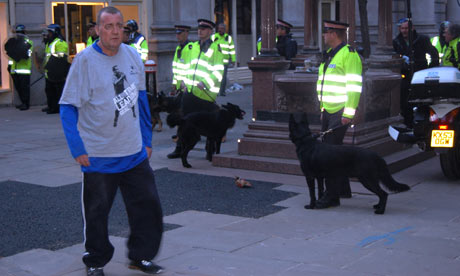
Here is a report from Andy, a Green Party member, on a vigil yesterday (April 2nd), called to remember Ian Tomlinson. It gives us an idea of what it is like to be kettled. It is noticable that police dogs were deployed, although the demonstrators were entirely passive. On April 1st, the riot squad marched at intervals through similarly passive demonstrators. There can only be one reason for this police behaviour: intimidation. And possibly, provocation. This report, and the picture, is copied from Another Green World - thanks Derek.
The vigil was well attended with a good few hundred people paying their respects, and placing personal messages on the boarding placed around a piece of architecture(?) outside the Bank. There was also a bit of a feeding frenzy of press and photographers, obviously looking for another bloody story and maybe some more confrontation between protesters and police. Eventually it appeared that the police might be looking for the same - their response was, like the previous day and in particular in the context of why we had gathered there today, wholly inappropriate.
A minutes silence was held, well observed by all who sat down, downed flags and removed hats to remember the fallen comrade; during the 'silence' the air was punctuated by the sound of police sirens and a helicopter hovering overhead. This was a sign of things to come.
Soon we were kettled in as police encircled the gathering. Police cossacks appeared in a show of force, but left after a while. Some mourners were becoming agitated, and there were chants of 'shame on you' aimed at the police. But there was no violence. However, eventually the police dogs were brought out as an intimidatory tactic, walked around the kettle for a bit then vanned off again. I could later hear them further up the road so I can only assume that other protesters were being harassed elsewhere.
Eventually some protesters decided to leave, but were being searched by the police as they left. The police closed in the kettle as people left and a few of us were left in a small space as the majority succumbed to the search in order to leave. 20 of us remained and sat down refusing to have to be searched. We calmly and peacefully discussed what we would all want to happen, a consensus was reached that we would all refuse to leave if we were to be searched and that we would be prepared to ba arrested. By this time we were just encircled by City of London Police, whose 'superior officer' was invited into the circle to address us. He informed us that a section 60 was in force in the City until 6am. After further discussion we decided that we would all be prepared to stay there until 6am. Further negotiation was attempted to allow us water and toilet facilities, but the request was refused.
By this time a small crowd was beginning to form around us and some people lobbed in some food for us, which was gratefully passed around. It was approaching half past five by now, and more people were gathering outside us, and a few pictures were being taken - the press vultures were still circling (apologies if anyone finds that description speciesist). Bemused city workers leaving work were curiously looking in, and taking a few of their own snaps for the family album. Then, all of a sudden the head copper came and told us that the police were going to let us go without being searched. Just like that. The police dispersed. We cheered and hugged one another as we realised that we had won. We gathered for a group photo and a wall of cameras recorded our joy for posterity. My fear is that this story of peaceful demonstration will be less than a footnote to the last couple of days as the press don't seem to want anything other than bloody anarchy and violence to scream out from their headlines.
Demo, April 4th, Bank of England
Demonstration: Saturday April 4
Assemble 12pm (sharp) Bank of England
We are taking to the streets to express our compassion with the family of Ian Tomlinson who tragically died during the 1 April protests at the Bank of England. We are calling for an independent public inquiry into the instances of police violence that occurred though out the week and to establish to true circumstances of his death.
Assemble 12pm (sharp) Bank of England
We are taking to the streets to express our compassion with the family of Ian Tomlinson who tragically died during the 1 April protests at the Bank of England. We are calling for an independent public inquiry into the instances of police violence that occurred though out the week and to establish to true circumstances of his death.
Ian Tomlinson: What happened?
Picture of Ian Tomlinson courtesy of Jasper Jackson (I think)
First, I would like to offer my sincere condolences to Mr Tomlinson's family at this dark time. I know what you are going through.
Obviously the full facts will have to wait for the coroner's inquest, and the Independent Police Complaints Commission report, but we do have some eyewitness accounts to piece together, and we should do this now to offset the distorted picture being put out by the corporate media. They have an advantage in being able to give false impressions in the heat of the moment, which are then cleared up with small print retractions and corrections later.
The Guardian has a good report:
Pictures seen by the Guardian, and corroborated by witnesses, suggest that Mr Tomlinson initially fell to the ground by a window of 11 Royal Exchange, outside the Mont Blanc shop, in front of five riot officers.
A subsequent picture shows him being lifted off the floor by a protester.
Seconds later, he is seen walking past a line of police dogs. He is believed to have collapsed again close to the junction of Birchin Lane, near a Starbucks and Office Angels.
Jackson said Mr Tomlison was then surrounded by police officers who were pelted with at least one missile.
"There were a couple of people throwing bottles in that general direction," he said. "But they were told to stop doing that by the crowd. In fact, some people in the crowd threatened to kill them if they did anything to disrupt the treatment."
-----------
Further account from the Guardian report:
"Jasper Jackson, 23, from London, who photographed Mr Tomlinson's collapse, said he had been standing in front of a line of police dog handlers minutes before he fell over. "The picture I have of him is of him stumbling in front of the protesters and in front of the police dogs looking dazed," he said. "He had a glazed look on his face. Then it was drawn to my attention that somebody shouted to the police with a loud hailer that there was a casualty and said, 'Can we get a medic?' ""
-----------------
"Another witness, Fran Legg, said she and a friend had rushed to help Mr Tomlinson after they realised he was not well. "People were calling out: 'Please, we need medics over here'," said the 20-year-old student, from Tavistock, in Devon. "Someone called an ambulance." Her friend put him in the recovery position and noticed he had blood on his face and was losing consciousness.
Legg said protesters were calling for people to move back and give him space as eight police officers arrived. By the time the ambulance reached the scene 10 minutes later, Mr Tomlinson was very white and could hardly breathe."
-----------------
"two demonstrators who had travelled from Manchester told how they saw paramedics attempting to resuscitate the 47-year-old.
"The officers were white as sheets," said Andy Bowman, a 24-year-old PhD student. "The blood had drained from their faces. They were giving us conflicting stories about what had happened; some of the officers were saying he had a blow to the head and some were saying he'd collapsed of a heart attack."
His friend Thomas Barlow, 26, said: "Some of the police were taking their helmets off, looking shocked.
"We were crossing the road and accidentally looked round and saw it.
"Someone called out, 'That person's hurt', and we went to have a look.
"The policemen around us tried to force us on very quickly.""
-------------
Here is another account, but it seems sketchy and emotionally charged:
"One female witness who wished to remain anonymous talked of “police brutality and heartlessness” and directly implicated members of the police force in the “murder” of the protester who, in tributes left outside the Royal Exchange in the city, was described as a “hero.”
She spoke of the “unwarranted” attack made by “masked policemen in riot gear.” After being struck in the head by a police baton she said the man was then bloodied and left unconscious on the street."
---------------
But this account is very hard to discount:
"My boss (yes, a senior manager at the bank I work at!) went over last night to see what was going on. He literally was next to the man who collapsed and died. He swears NO ONE was throwing a thing. And that the reason the police couldn't get to the guy was because the cops were using dogs against the protesters and the protesters were running away from them (towards where the guy was). Now interestingly, my boss said the guy looked about 50. The man who died went to the ground and started convulsing. So he seemed to think it was natural causes. But other than that bit, every single thing the police have said is wrong.
I will ask my boss to contact the solicitors, as he is a senior manager at the bank and a very unimpeachable source (in that the police can't say he was involved in any way or had any sympathies to the protestors - they can't just brush him off). But I won't hold my breath. He's a good man, but it may be too difficult for him to do (i.e. to stand up)".
----------------------------
And finally, here is Andrew Kendle's report from Red Pepper.
"A few minutes later, one of the protesters, a man in his 20s or 30s, collapsed on the pavement. The guy was totally out of it when I went to take a look at him. Protesters informed the police, and then allowed the police to carry the man back to their lines using what looked like a tarpaulin to carry him away. Twenty minutes or so later, after the police had used their dogs and more riot cops to clear Cornhill Street back up to Bishopsgate, two ambulances came up Grace Church Street and were let down Cornhill by the protesters and police to attend to the injured. I have since been able to confirm that the person who died was the one I saw".
----------------
Various participants in the City of London demonstrations on April 1st have come forward as witnesses to the collapse of a man later identified by authorities as Ian Tomlinson. Four different university students witnessed the collapse of Mr. Tomlinson. "He stumbled towards us from the direction of police and protestors and collapsed," said Peter Apps. "I saw a demonstrator who was a first aider attend to the person who had collapsed. The man was late 40s, had tattoos on his hands, and was wearing a Millwall shirt."
While the first aider was helping the man, another demonstrator with a megaphone was calling the police over so that they could help.
Natalie Langford, a student at Queen Mary, said "there was a police charge. A lot of people ran in our direction. The woman giving first aid stood in the path of the crowd." The running people, seeing a guy on the ground, went around them.
Another demonstrator had already called 999 and was getting medical advice from the ambulance dispatcher. "Four police with two police medics came. They told her [the first aider] to 'move along'.", said Peter Apps. "Then they pushed her forcibly away from him. They refused to listen to her [the first aider] when she tried to explain his condition."
The first aider, who did not wish to be named, said "The police surrounded the collapsed man. I was standing with the person who'd called 999. The ambulance dispatcher wanted to talk to the police, the phone was being held out to them, but the police refused."
Another witness, Elias Stoakes, added "we didn't see them [the police] perform CPR."
Other people who had tried to stay with the collapsed man were also pushed away.
All of the witnesses deny the allegation that many missiles were thrown.
According to Peter Apps, "one bottle was thrown, but it didn't come close to the police. Nothing was thrown afterwards as other demonstrators told the person to stop. The person who threw the bottle probably didn't realize that someone was behind the ring of police." All the witnesses said that the demonstrators were concerned for the well-being of the collapsed man once they realized that there was an injured person.
Natalie Langford said "when the ambulance arrived the protestors got straight out of the way."
These witnesses are happy to give media statements.
They can be contacted through this press liasion email: g20witnesses@gmail.com
See video of two of the witnesses giving their statement.
--------
Another protester, who refused to give her name, said she was with the dead man shortly before he died.
She said they were being chased by police dogs when the man in his 30s tripped and hit his head on the pavement at about 7.30pm.
She said: “Police dogs chased us all over London. We were running for about half-an-hour before the guy fell.
“We saw paramedics try to treat him. They said he was ok and he tried to get up but fell over again.”
--------------------
Those are all the eyewitness accounts I have seen, collected here in one place (they are also scattered in the blogs below).
Naturally they are inconsistent, because in any crowd situation, it is difficult to see what is going on beyond your immediate vicinity, and in an adrenaline charged situation with Bob Broadbent-Copper's kettling tactics in force, it is even more difficult to make out what is going on, but the urge to try to make some kind of sense of it is irresistible.
If Ian Tomlinson was on his way back home and got caught up behind the cordon, he would naturally have gone up to the Rioting Police and demanded to be allowed to continue on his way.
The question is - did they hit him? Blood is only mentioned in one account. However, a clout on the temple need not break the skin, but can break the temporal bone, causing a sub-dural haemorrhage to collect in the subsequent minutes, and the description of Ian looking dazed, falling, being helped up, and finally collapsing is consistent with that. The nervous behaviour of the police is also consistent with that.
On the other hand, he could have fallen and hit his head when the police charged.
I stress that this is pure speculation, because we do not know if he was hit with a baton or fell because of police charge. Either way, if the autopsy finds a sub-dural, the police are going to have some explaining to do. They have the advantage of being able to get together and create a consistent account among themselves, which the courts will tend to believe rather than accounts from demonstrators. That is why it it vital that any eyewitnesses come forward. Please, please do not think "There is no point in giving evidence, the system will not listen to what I have to say". Your evidence is vital, and if enough evidence is brought to bear, the courts will have to come to the right conclusion. A man died here, and also democracy and civil liberty received a blow. Your evidence can help Ian's family to know what happened, and also can help to roll back the spectre of brutal police repression of dissent.
More here , and by clicking the "civil liberty" label below, you will get everything on this blog about and around this tragic event.
G20 deal: strengths and weaknesses
George Monbiot sums it up well: "No expense is spared saving the banks. Every expense is spared saving the biosphere".
A trillion here, a trillion there for the banking system. (How the trillions trip off the tongue). An unspecified amount to "make the transition to clean, innovative, resource efficient low carbon technologies and infrastructure".
The strength lies in the fact that the world leaders are agreed in the Keynesian approach of Government investment into the economy; they are deaf to the ultra-conservative and libertarian ideologues, of which David Cameron's conservatism, or at least one phase of it's confused hodge-podge of sound bite policies, is a small part.
The weakness is that despite the best efforts of Sarkozy and Merkel (and fair play to them for pushing for regulation against the obsessive Anglo-Saxon free marketeers), the toxic assets are still at large, dark winged carrion eaters waiting to come home and feast on the cadavers of the world's banking system. The more Governments pump into the banks, the more they can dive their beaked and bloody faces into the swollen bellies of the system.
What is needed is the registration of all derivatives, their detailed examination for evidence of fraud, and to bring the astronomical debts back to bankrupt the accounts of the CEOs and bonus boys who bought into them. In this way, the debt will die with the bankruptcies. Without this, all the fiscal stimuli, past, present and future, paid into the system will disappear into cyberspace.
What is also missing is a clear, detailed and specific investment into a global Green New Deal.
This is the reality aspect of the whole affair. It is not just a financial problem that we face; there is also Global Warming and Peak Oil challenges to be addressed.
And another thing: there is a civil liberties problem. While the world leaders were inside the ExCel centre, socialising, concerned citizens were having a different sort of interaction: kettling.
The politicians have a choice; either they listen to the voice of the people, and bring us on board to work together to save people and planet, or they impose a perverse form of social order with shields and truncheons. The former leads to success; the latter leads to conflict and war.
The choice is ours.
A trillion here, a trillion there for the banking system. (How the trillions trip off the tongue). An unspecified amount to "make the transition to clean, innovative, resource efficient low carbon technologies and infrastructure".
The strength lies in the fact that the world leaders are agreed in the Keynesian approach of Government investment into the economy; they are deaf to the ultra-conservative and libertarian ideologues, of which David Cameron's conservatism, or at least one phase of it's confused hodge-podge of sound bite policies, is a small part.
The weakness is that despite the best efforts of Sarkozy and Merkel (and fair play to them for pushing for regulation against the obsessive Anglo-Saxon free marketeers), the toxic assets are still at large, dark winged carrion eaters waiting to come home and feast on the cadavers of the world's banking system. The more Governments pump into the banks, the more they can dive their beaked and bloody faces into the swollen bellies of the system.
What is needed is the registration of all derivatives, their detailed examination for evidence of fraud, and to bring the astronomical debts back to bankrupt the accounts of the CEOs and bonus boys who bought into them. In this way, the debt will die with the bankruptcies. Without this, all the fiscal stimuli, past, present and future, paid into the system will disappear into cyberspace.
What is also missing is a clear, detailed and specific investment into a global Green New Deal.
This is the reality aspect of the whole affair. It is not just a financial problem that we face; there is also Global Warming and Peak Oil challenges to be addressed.
And another thing: there is a civil liberties problem. While the world leaders were inside the ExCel centre, socialising, concerned citizens were having a different sort of interaction: kettling.
The politicians have a choice; either they listen to the voice of the people, and bring us on board to work together to save people and planet, or they impose a perverse form of social order with shields and truncheons. The former leads to success; the latter leads to conflict and war.
The choice is ours.
LibDem: Dangerous and intimidatory police tactics made G20 violence inevitable

(Thanks to Silversprite for this image)
Opinion: Dangerous and intimidatory police tactics made G20 violence inevitable says Liberal Democrat Voice
So it's not just Greens and Leftists who are disturbed by police tactics. That's reassuring.
A bit reassuring anyway.
Thursday, April 02, 2009
Another account of the City demonstration death
This account from an eyewitness of Ian Tomlinson's death at the police riot in the City of London yesterday actually says he was hit with a truncheon before collapsing.
See below, on the Kettle blog, for other eyewitness accounts.
Here is another eyewitness account. Ian was looking dazed, and was helped to his feet by a demonstrator at one stage. The police were looking shocked. In this account he was in the kettle.
Accounts in the media saying that he was just a worker on his way home are nonsense because nobody on those streets was allowed to move. If he was on the way home, he must have been corralled up.
Kettling has got to stop. Lois Austin is taking a case to the European Court of Human Rights.
See below, on the Kettle blog, for other eyewitness accounts.
Here is another eyewitness account. Ian was looking dazed, and was helped to his feet by a demonstrator at one stage. The police were looking shocked. In this account he was in the kettle.
Accounts in the media saying that he was just a worker on his way home are nonsense because nobody on those streets was allowed to move. If he was on the way home, he must have been corralled up.
Kettling has got to stop. Lois Austin is taking a case to the European Court of Human Rights.
Nuclear power builder Areva faces bankruptcy

It's all happening today
Stop Hinkley Campaign reports that a Hinkley C (projected new nuclear power station) partner is 'facing bankruptcy'
The French nuclear design and engineering company whose reactor is set to be built at Hinkley Point Areva is facing severe financial trouble.
The European Pressurised Reactor design favoured by EdF for building at Hinkley Point is owned by Areva.
Experts examining Areva's cash situation just days before its accounts are published show that it is "staring down the barrel of business failure" with a 3 billion Euro bail-out request from the French Government. Overrun costs of its reactor build in Finland have left the project facing a 5.4 billion Euro bill including an invoice to Areva of 2.4 billion Euros in penalties for lateness amounting to over three years. Embarrasingly for Areva, German engineering partners Siemans recently walked away from the project.
South Africa has cancelled a 12 reactor programme with Areva who were also forced to pull out of a Uranium mining venture in Canada. Potential nuclear contracts in Africa, the Middle-East and Eastern Europe have evaporated. Barack Obama has not agreed to a hoped-for $50 billion financial commitment to drive a nuclear renaissance in USA which might have helped Areva who had invested heavily in the country's nuclear future. Areva's shares have slumped by 60 percent since June last year.
Jim Duffy, (above), spokesman for Stop Hinkley said: "Other countries are pulling back from Areva contracts. They don't want to pick up the pieces of a failed nuclear industry. Gordon Brown should also pull the plug on the impending financial disaster that could happen here. Having been burnt by the banking industry taxpayers won't want to bail out a nuclear industry who may run out of cash when reactors are half built."
Update here (17.6.2009)
RL: I have always had an image in my head of abandoned half built nukes littering the countryside as 21st century follies. It was the fairyland finances of nukes that put paid to them under Thatcher. It looks as if money is still the nemesis of the nukes. How long will it take for this truth to penetrate into the musty dusty corridors of Whitehall?
Police "kettling" tactic must be made illegal

Ricky Knight and the Cops (good name for a band, Ricky - next time we must bring a set of gazoos for them)

Ricky not getting his banner past the nice cop

Drawing of nice cop holding Placard reading "Yes we can abolish nukes"
The Guardian has a report on the police tactic of "kettling" - penning protestors into an area and preventing them from marching. They have done this several times before in London, and they seem to think it is a good idea. Anyone with a GCSE pass in psychology, or to whom the word Hillsborough is familiar, will know that it is a stupid idea. It leads to fear, frustration and violence.
The peaceful, lightly policed Trafalgar Square demonstration was told that there was no violence or breakages in the Bank demo until the demonstrators had been kettled for two and a half hours. The Bank marchers were trying to get to Trafalgar Square to join the peaceful Stop the War march. There was little or no coverage of the peaceful march and rally. The media only reward violence with coverage.
The man in overall charge of the operation was Commander Bob Broadhurst. He must be made to justify his strategy. So far the courts have supported the kettling tactic, but this time we must get a mass of witnesses and specialists in crowd psychology and civil liberties to court in order to discredit and ban the tactic.
I had an entirely different experience with the police. I smiled at one officer at the edge of the march, and his face lit up. I asked a line of cops if they would arrest me if I took their picture. They said no, and one of them explained that the law against taking police photos had been brought in because some actors were publishing police faces on the web and asking people if they knew who they were and where they lived. This is clearly wrong, and the right response would be to find these websites and close them down if they contain threats of violence. Instead, they have brought in a law to forbid taking pics of any policeman (so a lot of newspapers are in breach of the law today). It is a bad law, because we can all break it by simply pointing our mobile phones at police. They cannot arrest us all.
After the first photo Ricky and I set off down Whitehall to get to our bus. Ricky was stopped by a polite and civil young officer who explained that placards were not allowed down Whitehall. Something about it might influence the weak-minded occupants of the House of Commons, they might get the idea that there was more to politics than claiming expenses, something like that.
I tried to get a picture of the policeman holding Ricky's placard, but unfortunately I am not yet in full control of my mobile phone, and missed the shot. In order to avoid disappointment I have rendered a line drawing of what the missed photo would have looked like. I let our a cheer when I took the picture, the nice cop looked embarassed and Ricky and I skipped down Whitehall with gleeful hearts, past ranks of police who were all smiling and smirking.
The point is that there is good policing and there is bad policing. April 1st shows them both in stark contrast. Kettling must be banned for peaceful demonstrations: people must always be allowed a way out. The penned protesters were pissing on the street. Not to mention the poor guy who died. Was he an asthmatic without his inhaler? Did he have a weak heart? Whatever the coroner finds, Commander Broadhurst must shoulder at least part of the responsibility for his death.
The point of all this is not that I am some pathetic middle class professional sucking up to the police. I am not, although it does help that I have had professional encounters with the police on plenty of occasions as a casualty officer, psychiatrist and GP, and usually find them very resonable. The point is that if and when the people believe that the time has come for them to exercise their right to replace the Government because the present lot has lost the plot, as happened in Iceland recently, then we need the police on side.
Tiananmen Square was a massive force for good, and the Chinese Government had to bring in forces from way out because they could not rely on local police to attack the demonstrators. It is when the human being within the uniform begins to see protestors as fellow humans who have a good set of points to make, that change happens.
We need to make clear the point of our demonstrations. Briefly and in essence, we need:
1 reform of the world's monetary system
2 work to decarbonise the economy
3 cancel the third world debt
4 demilitarisation
5 political and electoral reform
It is interesting that the police were at pains to break up the Climate Camp. It is only when demonstrations stop going home for a nice cup of tea at 5 pm that change comes about. And I confess that I was among those who did just that. But there will be other opportunities to assist in the coming months. La lutte continua
PS in chatting to the police, the issue of firearms came up. I mentioned the Green Party's policy of using more sniffer dogs to detect ammunition. He said yes they were great, but that dog units were expensive. I promised him that I would get the Green on the London Assembly on the case.
PPS Red Pepper Twitter reports that the police and ambulance crews who were treating the protester, in his 30s who so tragically died, were not pelted with bottles and sticks, as reported by the BBC. Who should we believe? In view of the police misinformation campaign around the Kingsnorth protest, when reported "police injuries" turned out to be wasp stings &c, not wounds inflicted by evil demonstrators, I feel inclined to believe Red Pepper.
I have just found this second eyewitness account that states that one or two plastic bottles were thrown from further back in the crowd, from people who were not aware of what was going on.
And here's a third testimony: My boss (yes, a senior manager at the bank I work at!) went over last night to see what was going on. He literally was next to the man who collapsed and died. He swears NO ONE was throwing a thing. And that the reason the police couldn't get to the guy was because the cops were using dogs against the protesters and the protesters were running away from them (towards where the guy was). Now interestingly, my boss said the guy looked about 50. The man who died went to the ground and started convulsing. So he seemed to think it was natural causes. But other than that bit, every single thing the police have said is wrong.
I will ask my boss to contact the solicitors, as he is a senior manager at the bank and a very unimpeachable source (in that the police can't say he was involved in any way or had any sympathies to the protestors - they can't just brush him off). But I won't hold my breath. He's a good man, but it may be too difficult for him to do (i.e. to stand up).
PPS Detailed, sound report here by the Big Green Factory. showing police provocation of peaceful demonstrators. I have filled in the card to join Liberty. I will send it off as soon as I am sure that they are going to take up the issue of police preventing demonstrators from exercising their democratic right of free assembly and freedom of speech.
More on kettling here.
Wednesday, April 01, 2009
G20 Police Riot
Just back home from the G20 demos. I was in the peaceful part, US Embassy to Trafalgar Square. The police couldn't have been nicer with us, in total contrast to the policing at the Bank, where they used their stupid penning up tactic. The organisers said there was no trouble before they were corralled around the Bank area. After two and a half hours scuffles started when people tried to escape. Now it is still in confusion. Twittering is happening now here.
Noel Lynch first hand account.
George Monbiot: The trouble-makers are out in force again. Dressed in black, their faces partly obscured, some of them appear to be interested only in violent confrontation. It's almost as if they are deliberately raising the temperature, pushing and pushing until a fight kicks off. But this isn't some disorganised rabble: these people were bussed in and are plainly acting in concert. There's another dead giveaway. They are all wearing the same slogan: Police.
A Green Party comrade who was in the Bank of England area writes:
The demonstrators at the Bank of England were peaceful: the police were brutal and used dangerous tactics to stoke the crowd up. The only way myself and other Green comrades managed to leave the demo was by following others who broke through the lines.
The crowd was very well natured. There is a lot of propaganda out claiming violence which is just untrue. The first window was smashed only when police appeared on horseback. 7 protesters hospitalized, 1 dead: only 1 police officer in similar position.
Police medics stood back and allowed pregnant women and parents with young children to be kept in the enclosure.
Noel Lynch first hand account.
George Monbiot: The trouble-makers are out in force again. Dressed in black, their faces partly obscured, some of them appear to be interested only in violent confrontation. It's almost as if they are deliberately raising the temperature, pushing and pushing until a fight kicks off. But this isn't some disorganised rabble: these people were bussed in and are plainly acting in concert. There's another dead giveaway. They are all wearing the same slogan: Police.
A Green Party comrade who was in the Bank of England area writes:
The demonstrators at the Bank of England were peaceful: the police were brutal and used dangerous tactics to stoke the crowd up. The only way myself and other Green comrades managed to leave the demo was by following others who broke through the lines.
The crowd was very well natured. There is a lot of propaganda out claiming violence which is just untrue. The first window was smashed only when police appeared on horseback. 7 protesters hospitalized, 1 dead: only 1 police officer in similar position.
Police medics stood back and allowed pregnant women and parents with young children to be kept in the enclosure.
Subscribe to:
Posts (Atom)


