Thursday, January 07, 2010

We Cannot go on Like This

Damn right we can't. Brilliant slogan by the Conservative Party. I suspect they mean "We need a change of Government, get rid of NuLabour Tweedledum and put the Conservative Tweedledee in its place".

Pity to waste such a fecund slogan on the Tory party, stuffed as it is with climate change deniers and promising a recession-creating programme of spending cuts.

The Green Party could usefully adopt their slogan:

  1. We cannot go on with burning carbon, because of climate change.
    Therefore:
    we need a massive investment in jobs in energy conservation.
    we need massive investment in renewable energy
  2. We cannot go on with Free Market Fundamentalism, because
    • it gave us the Credit Crunch
    • it is incompatible with dealing with climate change
    • it allows transnational corporations to act sociopathically.
      Therefore
    we must bring the banks and transnational corporations under regulation
    we must restrict the monopoly that the banks have on money production

  3. We cannot go on with militarism, because it only makes things worse.
    Therefore
    we will agree a diminishing, balanced and simultaneous reduction in military
    spending
    we will work to bring about international controls on dictators
    we will work to solve the problems in the Middle East
    we will peacefully solve the problem in Afghanistan
  4. We cannot go on with the political shambles in Westminster.
    Therefore
    we will bring in Proportional Representation, to create real competition between parties at election time.

  5. We cannot go on with the economic divergence between rich and poor
    -Intranationally
    -Internationally
    -Generationally
    Therefore
    we will bring in a Basic Income Scheme, a Tobin Tax, and many other economic reforms designed to create economic convergence.
  6. We cannot go on with the loss of our civil liberties. Therefore...er...Join Liberty
  7. &c. Feel free to add your own points below.

Climate Change Nihilism

Over on the Guardian Environment Blog, MangoJuice agrees :

that the globe is warming at a rate not seen in human history
that the polluting effect of the industrialised nations is the majority cause.
that it is grossly negligent and criminal not to harness all the free energy the sun, the wind and sea provide.

But MangoJuice is annoyed with the way some people go on about it

Well, pardon us for mentioning that business as usual means drought, flood, extreme weather, loss of low-lying fertile land and all the rest of it. Even putting down this little list makes me feel that I may be stepping on someone's toes.

"Best not to mention global warming. I mentioned it once, and they said I sounded like a prophet of doom".


But then Mango asks us to face facts and realise that no matter how loud and often we shout it is not going to make much of a difference. Global carbon emissions are going to rise and there is naff all you can do about it. The tipping point is almost upon us if not already here, and Mango asks: How can we efficiently get the green house gases out of the atmosphere and stored safely?

Mango, humanity is in a bit of a hole, climate-wise.
The First Law of Not Being in a Hole is - Stop Digging.

There is no logic in trying to sequester CO2 while the emissions are going full blast.

We can indeed reduce emissions, in a range of ways that starts with turning down the central heating and full loft insulation, going on all the way to Desertec and the HVDC supergrid.

And, yes, we can make a start on CO2 sequestration with reafforestation.

Third, there is a possibility that temperatures may not rise as fast as the models predict.

I am noticing that there is a real vogue for people to comment that It's All Too Bad, They'll Never Listen, You Wanna Give Up Mate, Like Me, That's the Way To Go.

Green activism is like having a parachute on a hang glider. It may or may not save your life, but in case of structural failure, it does serve to keep your mind occupied on the way down,

Tuesday, January 05, 2010

Letter to BBC on Gaza DEC appeal: 1p off my TV licence payment

For some reason, this page, explaining why I stopped my Direct Debit for my TV license has had a consistent stream of hits. This is an update:

Customer Services
TV Licensing
Bristol
BS98 1TL
5 Jan 2010

Dear Sir or Madam

I enclose a cheque for £142.49 as payment for my TV licence. As you will see, it is 1p short of the full amount. The reason for this is that the BBC refused to screen the DEC Appeal for Gaza. This decision was unacceptable. Irrespective of the provocation for Israel’s action by Hamas’ irrational and terrorizing rocket attacks, thousands of Gaza civilians were injured and rendered homeless by Israel’s operation.

The Geneva Convention states: Protected persons are entitled, in all circumstances, to respect for their persons, their honour, their family rights, their religious convictions and practices, and their manners and customs. They shall at all times be humanely treated, and shall be protected especially against all acts of violence or threats thereof and against insults and public curiosity.

The BBC Director’s decision went against the spirit of the convention by denying a proportion of the humanitarian aid that would have been raised as a result of the broadcast. It grieves me to have to take issue with the BBC, because I am a supporter of public service broadcasting, but I have to make a stand against political prejudice and anti-humanitarian tendencies on the part of the BBC management. My deduction of 1p is a small token of my dissent from the political decision made by your Director.

Sincerely.

..........

where the aid went

Guardian: the long march to May

Editor
Guardian

Your leader on "The long march to May" fails to mention the futility of the election campaign for most of the electorate. Under First Past the Post, Governments are chosen by swing voters in a handful of marginal constituencies, who form less than 1% of the total electorate. In safe seats, the incumbent MP is a shoo-in, and all votes cast for other candidates have no representation in Parliament. This is understood by the electorate, as is shown by the fact that turnout is inversely proportional to the majority of the sitting MP. The general election in safe seats is a highly expensive and pointless opinion poll. Rather than abstaining from the ballot, the best that anyone can do in safe seats is to vote for the party that stands for sustainabilty, equity, and a massive investment in work designed to conserve energy.


Dr Richard Lawson
Green Parliamntary Candidate for Weston-super-Mare

Weston-super-Mare Constituency General Election 2010: foregone conclusion, so vote Green


Richard Lawson, your Green Candidate


The opening salvoes of General Election 2010 are in the air.


I have the honour of being the Green Party's Parliamentary candidate for the Weston- super- Mare constituency (Conservative, safe).


2005 General Election
results:
John Penrose (Con) ...19,804 (40%)
LibDem ..................... .17,725 (36%)
Lab ...............................9,169 (19%)

Weston is a safe Tory seat. It is a quintessentially Tory constituency, with an ageing population. John Penrose is a decent Tory, a hard working MP, and has hardly flipped his home at all*.
Weston is a foregone conclusion; no contest; the winner of the 2010 election is...John Penrose (Con).

Of course, all parties will claim that it is not a safe seat, Tories because they have to avoid complacency, LibDems because they are second, and Labour because they believe that they can persuade people that 19% pigs can fly.

On the other hand, greens are realists, and I fully accept that John Penrose, not Richard Lawson, will be the next MP for Weston.

The 2010 General Election in Weston will be nothing but a glorified and very expensive opinion poll. There will be no change. Tory votes will elect an MP, and all other votes will be wasted. They will not count towards the make-up of Parliament.
People often believe that in General Elections they are choosing the next Prime Minister.
This is not the case.
Under a proportional representation, this would be so, but under the dysfunctional First Past The Post electoral system, no vote gets beyond the constituency boundary.

So the vote in safe seats is a sham, a travesty, a charade. People are not as stupid as politicians and pressmen believe, and the turnout in safe seats is lower than turnout in marginal seats.

Below is a graph I made of a sample of results from the 2001 General Election. Click on the graph to see it full size.


It clearly shows that the higher the majority, (i.e. the safer the seat), the lower the turnout.
Now politicians are, rightly, very worried about low turnout, because it shows a lack of regard for democracy itself. However, Tories and Labour both turn a blind eye to the facts presented by this graph, because FPTP serves the interests of both the Tory and the Labour parties, giving them more MPs than they would in a more democratic electoral system.

So the General Election in Weston is a sorry pantomime, a pretence.

The temptation to abstain from voting is strong, for any non knee-jerk voter, for anyone who actually gives some thought to things.

Attractive though it is, abstention is a huge mistake, a rejection of one's duty to preserve democracy.

Since only the Tory vote in Weston will get representation in Parliament, all other votes are just a statement of preference.

The Green Vote gives this statement:
  • people are not fooled by political spin
  • people want a change from the decrepit and corrupt politics of the Westminster parties
  • people want economic policies that match the real world, not ancient political prejudices
Over the coming weeks I will develop these themes here.

The Green vote in Weston will not produce an MP, (only the Tory vote will do that), but if people vote Green instead of abstaining, it will send a signal to Westminster that they have to take issues of sustainability, real economics, and fairness seriously.

I am debating on the Weston Mercury Forums site.


*Rather rashly, I promised in the press that I would not use the MP expenses scandal politically on John Penrose.

Monday, January 04, 2010

Carbon Trading Cowboys

I have written before about REDD, (Reducing Emissions from Deforestation and Forest Degredation) and how I think it is the only option on the table to save the forests. I went back to review some of the criticisms of REDD, and find my way over to the excellent Natasha Loader who details the dubious not to say corrupt practices of Kirk Roberts of Nupan Trading.

This charmer is signing up deals to buy land in Papua New Guinea, with a view to trading them on the carbon market as Redd (or other) offsets. At least one of his deals, Kamula Doso, is highly dodgy.

So, the UN in setting up REDD needs to look long and hard at the integrity of the carbon markets. It is mandatory that aboriginal forest dwellers are not displaced or put at a disadvantage by the carbon value of their home, but rather, are given an advantage as sovereign stewards of the forests.

But one instance of corruption does not invalidate the whole concept of REDD.

Sunday, January 03, 2010

Isn't Water Vapour the most important Greenhouse Gas?

This is one of the AGW skeptic's FAQs. They often quote that it gives 98% of the greenhouse effect, and only 2% for CO2, but this is an unsubstantiated factoid. It has no science to back it up*.

Even so, water vapour is the most important greenhouse gas, accounting for 33-66% of the total greenhouse effect, or 66-85% if we include clouds. CO2 accounts for 9-26%, and the other greenhouse gases (ozone, NO, methane) for 7-8% of the effect.

This is only the beginning of the story though.

Water vapour has a short residence time in the atmosphere - about 10 days, compared to decades or centuries for CO2, and decades for methane. This means that if the atmosphere is cooler, water vapour condenses, and falls as precipitation. If the atmosphere warms, more water vapour can be held, and its greenhouse effect goes up.

In short, water vapour is a passive component of the greenhouse effect, acting as a feedback to amplify whatever else is going on.


More on Real Climate

*Stefan, commenting on the Real Climate link above, says
I’ve seen a slightly different “98%” argument made by climate skeptics (e.g., U. Berner in various popular brochures and articles): “98% of the greenhouse effect is natural and only 2% anthropogenic”.
This is because the anthropogenic greenhouse gas forcing (~2.4 W/m2 until now, here IPCC is cited) is only ~2% of the total (“natural”) greenhouse forcing.
What these people usually leave out, of course, is that the natural greenhouse effect warms the surface temperature by ~33 ºC (all else being equal, notably albedo).
A rough and linear back-of-envelope estimate of how large the 2% anthropogenic change in greenhouse effect might be: 2% of 33 ºC is ~0.7 ºC, very similar to what the more detailed and correct calculation gives.
So, there is nothing wrong with this version of the 2% argument – except that it is often used in a context and in a way designed to mislead the public, i.e., it is used to suggest to a lay audience that “global warming is 98% natural”, so we are not responsible and can’t do anything about it.
Update 3.1.10: stratospheric water vapour may act as a negative feedback.

Climate change FAQs.
Warming oceans produce less clouds above them.

Saturday, January 02, 2010

Somali pirates: Something Must Be Done.

The British flagged cargo vessel Asian Glory has just been taken by Somali pirates.

Sometime soon, politicians are going to realise that Something Must Be Done.

The dictator Siad Barre was overthown in 1991, superseded by rule of the warlords. Eighteen years ago. Eighteen years of war, insecurity, and hardship for the people, made worse by an unprecedented drought, courtesy of Exxon Mobile associates (allegedly). Generally, the world has averted its gaze, apart from some decent diplomatic activity that set up the Transitional Federal Government, which has all the power and influence of a daddy long legs in a nightclub.

What to do? OK here's a few possibilities, off the top of my head:
  1. Set up a democratic panchayyat structure, based on traditional elders.
  2. Bring the non-Shabab part of the Islamic Courts Union into coalition with the TFG and other big players - on condition of no stoning and amputations, no oppression of women or gays. (The ICU are not all bad. We need a trial run for when the Taleban get to share power in Afghanistan).
  3. Clamp down on borders, confiscate all arms.
  4. Use sniffer dogs liberally, to find ammunition.
  5. Control the waters, with permission of the TFG
  6. Start work on reafforestation and water infrastructure.
  7. Stop overfishing Somali waters.
  8. &c. There are 500,000 civil servants in the FCO. They must have a few ideas among themselves. And they are paid to think. I'm just a jobbing blogger.

Telegraph Collection Gas Energy Saver : Do Not Buy!


As an inventor, I was thinking about our gas stove, and how to increase the efficiency of heat transfer from flame to saucepan. I was doodling about with a design, and in researching it, found this item here. On the Telegraph marketing site.

Great. One less thing for me to do. So last May I bought a pair (£21 inc p+p) online.
They sit on the flame, go red hot, and as it says on the site,
"Most gas hobs burn gas inefficiently, resulting in expensive bills for your family. The Gas Energy Saver solves this problem by using a special catalytic alloy disc to convert all the unburnt gas to heat and energy instantly.

It fits all gas hobs, neatly sitting on your job, heating to over 1000oC, dramatically reducing your cooking time. The special stainless steel alloy is dishwasher safe. Measures 14x1cm (51/2x1/4in)".

Get that? "Dramatically reducing your cooking time".

Seven months later, I decided to quantify the amount of gas I was saving, with the following

EXPERIMENT

Method

Turn on gas, and leave it on at the same rate.
Take one saucepan, fill with one full egg-cup of water from the cold tap, place on flame, first with the Gas Energy Saver grid in place. Hit start button of stopwatch. Observe when boiling starts, which is taken as substantial bubbling occurring at the edge of the water. Record time. Remove grid, discard water (into a thermos flask, if you must know, so as to conserve the heated water), remove grid, refill saucepan with the same amount of water, and repeat.

I tried to keep the timings of the actions I took as regular as possible.

In all I took 16 readings, 8 with the Energy Saver Grid (ESG) in place, and 8 in the normal way, with the pan just sitting on the gas hob.

Results

Number of seconds to end point with ESG in place:
106, 44, 137, 156*, 62, 145, 80*, 149
* = end point taken as evidence of boiling dry, with dry pan appearing before boiling was observed.

Average time to boil using the ESG : 110 seconds

Number of seconds to end point without ESG in place:

73, 28, 32, 60, 51, 51, 53, 43
Average time to boil without using the ESG : 49 seconds

Discussion
There was a wide variation in the readings of the "Energy Saver" compared with the readings for the ordinary flame. This could have been due to variations on how the ESG sits on the hob, as it has a toothed structure, which if they are not bedded down on the hob, may hold the pot further from the flame, or not, depending how it is situated. It may be supposed that the device fails because it holds the pot further from the flame.

Conclusion
The Gas Energy Saver has been wasting a significant amount of energy. It is surprising that no trials were carried out on the invention before it was put on the market.

The appliance is not recommended by this blog.

Declaration: No money changed hands in connection with this experiment.

I will now have to fashion and trial my own design to increase the efficiency of heat transfer from flame to saucepan. Bother.

[update 25.1.10: Still no reply from the Telegraph Collection to my letter. 3 weeks now. It was just a polite letter of information. Perhaps they would reply if I mention the Trades Descriptions Act.]
[update 1.2.2010: Just got this email:
Your message

To:      Customer Services
Cc:     
Subject: Gas Energy Saver Trial
Sent:    Mon, 25 Jan 2010 19:38:10 -0000

was deleted without being read on Tue, 2 Feb 2010 16:16:00 -0000

Great. I'll send it again.
 
Update: a lab test contradicts my findings. 
The reason for this is that I was using my apparatus upside down. Which might appear to be stupid, but I was following the picture of the item. 
So now, when I get a round tuit, I will find the items, and repeat the experiment with them the right way up.

Copenhage Accord, two weeks on

It is nearly two weeks since the Copenhagen Accord was struck, and the best I can say about my comment now is better late than never, and maybe it is better late, rather than in a rushed comment as soon as it comes out. I am of the glass half-full persuasion, and take Cop15 as a beginning to build on. These are key excerpts from the document .

1 We underline that climate change is one of the greatest challenges of our time. We emphasise our strong political will to urgently combat climate change in accordance with the principle of common but differentiated responsibilities and respective capabilities. To achieve the ultimate objective of the Convention to stabilize greenhouse gas concentration in the atmosphere at a level that would prevent dangerous anthropogenic interference with the climate system, we shall, recognizing the scientific view that the increase in global temperature below 2 degrees, on the basis of equity and in the context of sustainable development, enhance our long-term cooperative action to combat climate change.

OK. It's a start.

4. Annex I Parties to the Convention commit to reducing their emissions individually or jointly by at least 80 per cent by 2050.

Annex I are rich industrialised nations. 80% is not sufficient, it needs to be 90%, but again, it's a start.

5. Non-Annex I Parties to the Convention will implement mitigation actions, including those listed in appendix II, consistent with Article 4.1 and Article 4.7 and in the context of sustainable development. Mitigation actions subsequently taken and envisaged by Non Annex I Parties shall be communicated through national communications consistent with Article 12.1(b) every two years on the basis of guidelines to be adopted by the Conference of the Parties.

Weak. Reporting only, no targets, but assistance from rich nations, for example with installing solar technologies will be monitored; which is sensible.

6. We recognize the crucial role of reducing emission from deforestation and forest degradation and the need to enhance removals of greenhouse gas emission by forests and agree on the need to provide positive incentives to such actions through the immediate establishment of a mechanism including REDD-plus, to enable the mobilization of financial resources from developed countries.

This is fiercely, and in my view, irrationally opposed, by many environmental groups. The challenge to them is to provide their alternative mechanism to protect the forests. I believe the key point we should aim for is to grant indigenous forest dwellers protective sovereignty over their territory.

7. We decide to pursue various approaches, including opportunities to use markets, to enhance the cost-effectiveness of, and to promote mitigation actions. Developing countries, especially those with low emitting economies should be provided incentives to continue to develop on a low emission pathway. 8. Scaled up, new and additional, predictable and adequate funding as well as improved access shall be provided to developing countries, in accordance with the relevant provisions of the Convention, to enable and support enhanced action on mitigation, including substantial finance to prevent deforestation (REDD-plus), adaptation, technology development and transfer and capacity-building, for enhanced implementation of the Convention. The collective commitment by developed countries is to provide new and additional resources amounting to 30 billion dollars for the period 2010 - 2012 as listed in appendix III with balanced allocation between adaptation and mitigation, including forestry. Funding for adaptation will be prioritized for the most vulnerable developing countries, such as the least developed countries, small island developing states and countries in Africa affected by drought, desertification and floods. In the context of meaningful mitigation actions and transparency on implementation, developed countries support a goal of mobilizing jointly 100 billion dollars a year by 2020 to address the needs of developing countries.


No detail. the £100 billion is about half of what the UN estimates as necessary. In comparison with the amounts shovelled into the banks last year, it is modest, and the disparity shows the cognitive dissonance on the part of leaders between the real world and the fantasy world of finance.

12. We call for a review of this Accord and its implementation to be completed by 2016, including in light of the Convention's ultimate objective. This review would include consideration of strengthening the long-term goal to limit the increase in global average temperature to 1.5 degrees.

This represents a failure of the hope that the Convention would be made legally binding within 6 months. 2016 is just ridiculous.

So. It's a start, and it gives us an opportunity to lobby our Governments for tighter action.
But first we need to set our own house in order, with regard to protecting the forests.

Also, we should be lobbying the Government to start taking some real action, instead of just talking. A serious building insulation programme should be in the next budget, and also a plan to make public transport cheaper and more user-friendly.

John Major, Saddam, Blair - and what to do about dictators?

John Major on Today programme condemns Tony Bliar's argument that his Iraq war was justified because it removed Saddam.

Quite so.

But do we have to therefore just tolerate dictators, no matter what they do, because war just makes matters worse?

Green Party policy is to get the UN to report on the human rights performance of all states on a yearly basis, publishing the results, and bringing non-violent, legal pressure on the dysfuncitonal regimes. We are also going to vote at our next Conference (Feb 18-21) on means of bringing immediate non-violent pressure on the oppressive regimes.

More here.

Friday, January 01, 2010

Climate change: what if solar input falls in coming decades?

Fig 1
This graph is from NOAA. (click to enlarge) The top graph is of temps since 1720, the middle is of all the studies since 900 BP (=AD) and the bottom shows the probability of temperatures - the central dark areas being the most certain, and the lighter extremities showing the outside possibilities.

This is the result of many scientific observations, and it shows clearly that recent temperatures, since 1970, are way out of line with previous averages.

The Medieval Warm Period (apologies about the spelling, but proper spelling may get missed on North American searches) does show, but modern trends exceed that warming.

Clearly, the pre 1800 temperatures could only be down to natural variation with a tiny input from wood burning.

On this next graph I have combined solar variations with the temperature record.
(all other graphs are sourced from Robert Rhodes' excellent Global Warming Art). The brownis fuzzy line is the global temperature, and the grey dotted line is solar activity, increasing if the line is going up.
(Sorry about the appalling graphic quality: I had to stretch, invert &c to match the date lines up.)
Fig 2


Interestingly, it suggests a correlation between drops in solar output, but not much of a correlation with increases of solar output, except in the 20th century.


The next graph below shows what has been happening in recent years.

Fig 3


Solar activity has been falling since 1978, but temperatures continue to climb, although the last decade has been flat.

Skeptics make much of the flattening or fall in temperatures since the peak of 1998, concluding, as is their wont, that "This disproves AGW".

My view, which is of an interested bystander, not of a climate scientist, is that this recent flattening of the temperature line reflects the 11-year solar cycle, which is in decline at the moment, and is due to pick up in 2012, although more recent observations show that this upswing is delayed.

Fig 4


This is the short term cycle, which is only weakly related to temperature, as we can see from the combined to the left here.


Below I have combined sunspot activity since 1960 with smoothed temperature since 1960, and we can see a persuasive fit between them. The sunspots (red and blue, at bottom) are in phase with the sinuous fluctuation of the rising temperature red line.

Fig 5


This match is not of course conclusive. There is a small hump on the temperature at the same time as a trough in the solar cycle, and in order to convince that two series are in phase, there has to be a far longer match than the four we have here. But it does give an indication.


Now, what about the longer term solar cycle?

Below I have pasted a version of the long term solar activity graph with a speculative continuation of the longer term solar cycle, shown as a red line.

Fig 6
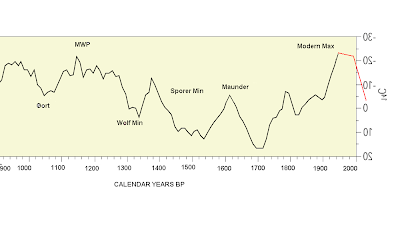
If there is a long term fall in solar output due, it may reduce the warming drive in the 21st century. Global temperatures could possibly even fall, since the first graph shows that falls in solar output are associated more strongly with falling temperatures than rises in solar output are associated with rising temperatures.


I stress that this line of argument is not science, just impressionistic speculation. I put it up here to show that models do include all factors. It is not either greenhouse gases or solar, but both greenhouse and solar, together with all the other factors, known and unknown.

The danger is that the statement "Global temperatures could even fall", coming from a Green AGW apologist and advocate of rapid decarbonisation, will be seized on by the skeptic lobby, as a victory for their business as usual, keep burning carbon scenario.

It is nothing of the kind. I have definitely not gone over to the other side. At the end of 5 weeks' intensive study of the arguments, I am more deeply convinced than before that AGW theory is correct, and that the only reasonable policy response to the global situation is to decarbonise the economy as a matter of urgency. I am also more firmly of the opinion that the driving force behind AGW skepticism is the psychological defence mechanism of denial, covered with a thin veneer, in some cases, of selective and partial deployment of scientific facts and reasoning.

The line of argument presented here, that the long-term solar variation may take the pressure off the rising global temperature, is just a possibility. I have drawn a falling line, reflecting the peaks 200, 400 and 600 years ago. If the next peak is more like the plateau in the Mediaeval Warm Period, global warming will increase in line with IPCC projections. Policy responses must be matched to this worst case scenario.

We can and must decarbonise the global economy for four reasons:
  1. reducing the greenhouse effect,
  2. because of Peak Oil,
  3. because of ocean acidification,
  4. because it will re-balance the divergent international economy by giving hot developing countries an income from solar power.
If there is a slight fall of temperature in coming years, this does not "disprove" AGW; it merely gives humanity breathing space to secure an equitable, sustainable future.


PS I could be totally wrong on this. Even a Grand Solar minimum might not have a significan effect. 


Solar change and climate: an update in the light of the current exceptional solar minimum, Mike Lockwood
Climate change FAQs.