Showing posts with label UN. Show all posts

Friday, May 04, 2012

The UN's response to Arab Spring and UN reform

Last Wednesday (May 2nd) I went to the House of Commons for a meeting called by the All-Party Parliamentary Group on the United Nations on "The UN’s Response to the Arab Spring and the Evolving Role of the Security Council".
 
It was chaired by Lord Hannay of Chiswick - Former British Permanent Representative to the United Nations (1990 – 1995), who, uncannily, looks more like Sir Humphrey than Nigel Hawthorne himself.

The speakers were His Excellency Sir Mark Lyall Grant KCMG* - British Permanent Representative to the United Nations (2009 - present) and Sir Jeremy Greenstock GCMG** - Former British Permanent Representative to the United Nations (1998 – 2003) and Chairman of UNA-UK .

So this was all stuff from the horse's mouth. We were listening to polished voices that speak (or have spoken) in the United Nations Security Council (UNSC).

I am going to touch a few highlights of what they said.

Sir Mark reviewed the Arab Spring - or, as he would prefer, Arab Awakening. The UNDP was one of the few bodies that predicted  the Arab Spring, in a 2009 report. The UN had been involved in helping to bring about democracy, by suspending Libya from the Human Rights Council, referring Gaddafi to the International Criminal Court, and offering accreditation to the Libyan opposition, the TNC, in the General Assembly.  The Libyan action is still contentious in some quarters. 

Some also are still critical of the policy of Responsibility to Protect. Although R2P is mainly supported by Western conscience, non-Western nations like Qatar and Turkey also support it.

He sketched out Ban Ki Moon's agenda for his second term of office, especially his desire to push through reforms. The UN is pushing on to its 70th year,  its bureaucracy has become sclerotic and badly needs reform, but there is much resistance from some states to reform.  He drew an analogy between the democratic impulse of the Arab Spring and the need of the UN to listen to ideas coming up from the grass roots.

He looked at the future of UNSC action. There are about 100k UN peacekeepers deployed at present, and he sees this number dropping, being converted to more specialised and more police-like, intra-state activities, rather than the traditional blue-helmet peacekeeping ops between states.

Regional organisations - such as the Arab League - are going to become bigger players. He pointed out the disagreement between the Arab League and the African Union over Libya.

Jeremy Greenstock - current chair of the UNA-UK board - took over, with a view of the structure of UN action. The Universal Declaration of Human Rights and the UN Charter remain the linchpin of UN activities, and those principles must always be upheld. 

The legitimacy of Governments is always determined by the people. The Arab Spring will not be limited to the Middle East, but will inspire similar movements worldwide. The Israel/Palestine issue must be resolved, and - remarkably - he said that the Quartet (run by one T Blair) initiative is running out of steam.

Questions followed. I asked whether UNA-UK should look at the idea of setting a framework for the UN to work to, rather than the present ad hoc arrangements, in order to speed up reaction to events like Syria, where a year and 10,000 deaths have passed before action begins to be brought to bear.

Mark Lyall Grant said we must take the world as it is. The UNSC veto would put paid to any attempts to speed things up. However, the idea of  discouraging the move towards dictatorship does find some resonance with the USA's "Horizon Scanning" process. I did a search, but was unable to find a link to this as a general process, though I did find this on Rwanda

Jeremy Greenstock said that responses to humanitarian crises such as Syria and Bahrain tend to be initiated by Western conscience and NGOs. He stressed that democratic governments are not good at committing money for long term plans.

All three on the platform assumed that I was trying to bring forward the point at which the UN authorises military action against a violent dictator - which is of course the very opposite of what I was proposing. This shows the difficulty of trying to compress a comprehensive idea into a question. 

However, I did get some support from other attendees at the meeting, and an opportunity to write to Jeremy Greenstock. 

So it was all worth a trip to London, which remains a funny kinda place.


---------------------------------------

* KCMG = Kindly Call Me God
** GCMG = God Calls Me God

Wednesday, March 23, 2011

Two things we can do to help resolve the Libyan situation

Just emailed this to the  Letters Editor at the Guardian. You can too if you like, by using the copy, paste and edit facilities provided by your computer.


To Letters Editor,
The Guardian

With regard to Libya, either can sit down and theorise about what went wrong, what is going wrong, and what will go wrong in the future, or we can press our democratic representatives to call for two courses of action that have been left out of the picture so far.

Static armchair analysis no doubt meets a need for some, but dynamic action calculated to bring on an early victory for the pro-democracy revolutionaries has got to be the way to go. The question, "How will it end?" is meaningless. Nobody knows what the future holds: the best we can do is to try to make a beneficial outcome more likely.  There are two things that we can do.

First, we can ask the MoD to close down Ghaddafi's broadcast facilities.  Libya State TV is the means whereby Gaddafi spreads his delusions to such of the Libyan population still support him. It is clearly inappropriate for a deluded individual to be permitted to spread his delusions through a TV station, especially when he is in the process of destroying whole cities. If Churchill had the means of applying tape to Goebbel's mouth, he would certainly have used it. The Government has been silent for over a week on whether they will be pursuing this course of action. It is time they stopped debating it and started doing it.

The second is to ask William Hague to get the UN to lean on Chad, Mali and other countries who are sending mercenaries to Libya. They must be persuaded to force the recruiting agencies in their countries to recall their dogs of war. Again, we have heard nothing about this course of action, not even that it is under consideration.

These two simple, positive and non-violent actions would help enormously  to bring democracy to Libya, and by extension, to countries waiting in the wings for their turn in the revolutionary limelight. They are actions to which everyone, whether hawkish or doveish, can lend a hand.

Sincerely
[name, address, tel no]

Friday, January 15, 2010

Haiti: potted history

The following is a precis mainly from this Guardian G2 article by Jon Henley, which does not yet seem to be up on its website.

1492 Ayiti (meaning mountainous area) discovers that Christopher Columbus has bumped into it accidentally. Calls the island Hispaniola, but Spain finds more gold elsewhere, and leaves the island to buccanneers.

1665 France claims the island

1695 France and Spain divide the island, the French bit, Haiti being called Saint-Dominigue. France brutally exploits the island's rich productivity, importing up to 40,000 slaves a year to replace the dead.

1791 Inspired by the French Revolution two years earlier, the slaves have their own revolution against the French. 12 years of civil war follow.

1804 Haiti is independent, but has to pay France 150 million francs in gold. The final repayments are made in 1947, but only by incurring huge debts with private banks. In 1900, 80% of the Haiti GDP was going in debt repayments.

Despite this, culture flourished until a revolution in 1911, followed by 20 years of US occupation. Political instability from 1931-1957, when Jean Claude Duvalier took over. He did some good for education and was an exponent of Haitian culture, but eventually became a brutal dictator. He and his son killed between 30-60,000 people, terrorised the population, and stole the country's wealth. 80% of international aid donations were embezzled.

1986. Baby Doc goes into exile in France, taking an estimated $900 million with him (though Wikipedia says he lives modestly in Paris).

1986- Post dictatorship unrest.

2000 - political confusion. Pres Aristide popular but alledgedly corrupt. Removed by US Marines.

2004 - UN peacekeeping mission (MINUSTAH) in place. "Critics have criticized MINUSTAH as an attempt by the United States, Canada and France to oust Haiti's democratically elected populist president Jean Bertrand Aristide, neutralize his supporters of Fanmi Lavalas, and secure the more pro-Western government of Gérard Latortue." (Wikipedia)

I peer reviewed an academic article a few years ago that alleged abuses by UN troops, but it was withdrawn because of apparent political bias.


Present position

The country is 98% deforested, making it liable to floods, topsoil loss and landslides.
Overpopulation: 9 million, 80% under the poverty line.
2009 GDP $2 per day per capita.
Unemployment rate 75%
66% work in subsistence farming.
Much activity in drugs, weapons, gangs, kidnapping and extortion.
80 deaths per 1,000 live births.
It is 149th out of 182 on the Human Development Index
168 out of 180 on the Corruption Perceptions Index
225,000 children live as house slaves.

Which all goes to confirm that Haiti need more than a physical infrastructure rebuild, it needs a full economic and social restructuring along green lines.

Haiti: UN must set up International Rescue agency

To develop the thinking on disaster response in Haiti: the present problem is that we have a bottleneck at the ports. The airport is stymied because it has run out of fuel to get planes out again, and its storage areas are saturated. The sea port is handicapped because the cranes are damaged.

It is easy to criticise the response to an emergency of this size, but it truly does not have to be like this. The delay in getting aid in is unacceptable.

The plan put forward to the UN a few years ago, for an International Rescue Task Force, (the title was consciously cribbed from Thunderbirds), with a chain of military based depots situated at strategic locations around the world, is worth more consideration. The depots would be on 24/7 standby, and a team of surveyors should be on site in disaster zones within hours of the event. They would have experience in organisation and would coordinate the efforts of the various aid agencies, who otherwise can duplicate efforts and get in each others' way.

Their first task would be to secure transport routes, to bring in fuel to the airport to get planes out again. They would identify and prepare storage areas, and facilitate the necessary burial procedures. That needs digging equipment. They would send teams to get the water supply network running again.

Digging people out from under buildings requires Infra Red living body detection items, and these should be made available on the first incoming flights. Heavy lifting equipment to lift collapsed buildings can only work if roads are clear, so bulldozers should come in before them.
Jacks and Acro props may be better for individual manual work earlier on in the rescue effort. It will be argued that attempts to rescue trapped people may result in more injuries from collapse, which is true, but this must be balanced by the overwhelming motivation of a father to rescue a trapped child.

At the same time as this centralised heavy duty stuff is running, community strength needs to be mobilised. After a disaster, people go into "shock", a derealised state - a kind of emotional numbing. Post Traumatic Stress Disorder (PTSD) sets in. Some are totally incapacitated by this state, but others with a milder case can be mobilised to help others worse off than themselves, which is in itself therapeutic.

There is much to be learned from the Haiti disaster, but the most important opportunity is to press the UN to set up a specialised agency to tackle future disasters more efficiently.

Sunday, September 20, 2009

East African drought: there is a solution

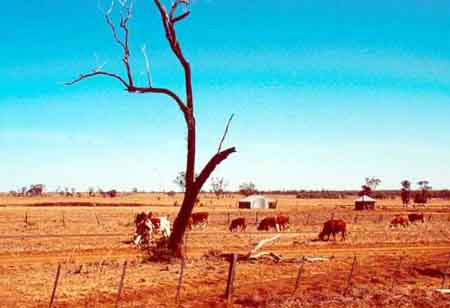
Image from the Environment Society of Australia with thanks

East Africa is in trouble. Somalia, Djibouti, southern Ethiopia, northern and eastern Kenya, and northeastern Uganda all affected. The World Food Program says that 23 million people are in need of emergency food relief. Food prices are rising. There has been a steady decline in rainfall over the last 20 years, rainfall patterns are less predictable.

It looks as if the climate in the horn of Africa is changing, consistent with man made global warming models.

Scarce water, scarce resources, means trouble. Population displacement, refugees, tribal conflicts. It is adding to the misery in Somalia, weakened by 18 years of internal war.

Heavy rain is expected next month, due to El Nino, but this may bring its own problems.

What to do?

First and foremost, we must hope that the politicians gathering in Copenhagen this December come up with a serious plan to de-carbonise the world economy. We can all help through Avaaz.

Even a serious, rational plan to decarbonise will not help with the East Africa situation in the short term though.

The region needs a big change in the water cycle, in a short time scale.

This is not impossible. It could be done by a massive reforestation effort, beginning at the coast, and working inland.

The key fact to know is that according to Nobel Peace Prize winner and Kenyan Green Belt Movement founder Wangari Maathai, a patch of growing rain forest 15 square kilometers in area will create its own raincloud.

It is well known that forests act as a sponge, holding water, and lifting it into the air through evaporo-transpiration. Usually, this fact is deployed to make the case against deforestation.
It is equally effective as an argument for reafforestation.

The afforestation must begin at the coast because the onshore winds are moisture laden, and can help the new forest to flourish. Solar desalination stills set up by the coast can generate the fresh water that tree nurseries need.

These projects will need major international backing, with serious
money (but not prohibitive, by military standards). The planting must be carried out by and with the willing and informed consent the local communities, providing work, shelter, and benefits to those communities. And before anyone starts screaming about non-native monocultures, the species planted will be indigenous to the area, and planted with ecological sensitivity. Permaculture principles should be used.

The creative, cooperative activity required in local communities will displace energies from war making and conflict in Somalia, if rightly implemented, with good leadership from people committed to peace and democracy in Somalia.

More detail on coastal reafforestation here.

Yes, it is a big project. Yes, it is a new idea. But the journey of 10,000 miles starts with a single step.

For East Africa, this is that step.

See also:
Water Project in Israel/Palestine
Leonard Ornstein has similar concept.

Thursday, June 25, 2009

Iran: Laissez faire is not an option

There is a view in circulation that the "West" has done much harm in its intervention in the affairs of other nations, and therefore that we in the West should let non-Western governments to do precisely what they please.

This is a common view, and one that comes with a great deal of passion behind it. However, the position deserves a little analysis.

The first part of the proposition is true to a large extent. Not all of our interventions have been malign, (the Sierra Leone intervention was broadly successful) and not all of our malign interventions have been 100% bad in their effects (the Iraq invasion did at least get rid of Saddam Hussein).

But even if the first part of the proposition is true, the second part does not necessarily follow.

Take an analogy. A patient has a serious illness. Treatments tried so far have been unsuccessful and the side effects have been deleterious. It does not follow that the patient should just be left to die, with no further treatment should be attempted. It does follow that in future, treatments should be more carefully considered, and a different approach to treatment would be preferable.

In the case of Iran, it looks as if the West has learned that its interventions are counter-productive. Obama has rightly avoided backing the demonstrators, because to have done so would have been to hand ammunition to the Iranian government, who would have been able to demonise them as USA spies.

On the other hand, the world cannot just sit back and watch while the Basiji, Khameni's militia, use clubs, axes, and guns to beat, hack, and kill unarmed civilians in the streets of Teheran and other cities.

Why not? Because some of us have seen it. What the eye sees, the heart grieves about. In the past, we have been dependent on the media who chose what we should or should not see. Now to some extent, the new technology has bypassed the media (media=middleman) and the information is available irrespective of what our masters want us to see.

Videos from mobile phones have been uploaded to YouTube. Tweets have given the location of the videos. People have been able to see what the word "brutality" means in flesh and blood. The videos provoke emotion. Emotion means e-mote - that which motivates.

We, the people who see with our own eyes the brutality of tyrrany, we are motivated to help our brothers and sisters in Iran. So we sign petitions. We change our icon to green. er...we can demonstrate outside the Iranian embassies. No point in writing to our MPs in this case, because the UK Govt can do nothing (see above).

There is one other thing that we can do. We can press the United Nations to act.

Take another analogy. Imagine a school playground where a lot of bullying is going on. The biggest bully has been doing a lot of bullying, but is now getting too physically tired from his bullying to do any more bullying. The kids notice that another bully is bullying a very small kid, first stealing from him, and then beating him up when the very small kid complains. What to do? Leave it to run its natural course? The small kid may be maimed or even die, and bullying will continue. Call on the bigger bully? He is too tired, and is beginning to realise that bullying is not the answer.

The answer is for the whole playground to get together and lay down some rules regarding bullying. And to enforce the rules by acting together in concert, not by beating bullies up, but by consistently stopping their treats and priviledges until they stop bullying.

This is what the United Nations is for. Yes, it's not popular, nor is it 100% effective or perfect.
Yes, the UN idea need to be taken further, both in terms of its processes and in terms of its remit. The Green Parties of the world are leading its framework reform, calling for the UN to move from a reactive to a pro-active stance with the Global Index of Human Rights.

As it is, the UN is a flawed organisation, but is is better than a policy of laissez faire, whether of the Right or of the Left. Because that is what this idea of "we should not interfere" actually amounts to.

Wednesday, May 20, 2009

Sri Lanka - a separatist war ignored by the world

I feel a sense of personal collective shame that the international community has not paid more attention to the Sri Lanka civil war.

Personal, because my next door neighbours for many years were Sri Lankan Tamil exiles, and they were the among the most pleasant people I have ever met.

The LTTE have been characterised as "terrorist", but I do not know of the evidence. Did they use violence against civilians? Has the Sri Lankan Government used such violence? I suspect that the answer is that both sides did so.

We can contribute to a structural UN reform, where the UN has an office to brokering negotiations over separatist aspirations.

Secession is not a rare phenomenon. There are about 110 places in the world where the people of a region feel uncertain about whether they are living in the right country or not. Of the 37 ongoing armed conflicts in the world, one third have secession as their main motivation.

This raises the possibility that instead of responding to wars in an ad hoc way with the usual intense diplomatic activity and the rest, the international community could lay down a framework of rules to enable reason and negotiation to take place of emotion and gunfire.

Prevention is better than cure. Clausewitz’ famous aphorism was that “War is the continuation of politics by other means”. This should be updated to “War is the continuation of politics by irrational and inhumane means”. Whatever form of words is used, it is clear that politicians have a duty to agree some rules and protocols on separatism, in order to extend the reach of politics to cover this common political situation.

Democracy should have a bearing on the matter. If it is truly the will of the people of a region that they should not be governed by their present rulers, then politicians should give attention to their wishes.

Does the majority of the people truly seek independence or autonomy, or is it simply the desire of an unrepresentative political group? This is a question that can be answered by referendum. Since it is unlikely that the state will be happy to offer a referendum, the process will have to be initiated by a people’s petition, which in some cases will have to be organised in secrecy. Once the designated agency of the UN has received the petition, they can research and evaluate the situation. If they decide that there is a case, negotiations leading up to a referendum can start. If the result of the referendum shows that a two thirds majority (say) is in favour of autonomy, negotiations can start, under the guidance of the UN or regional authorities.

Negotiations will be complex. No state wishes to lose bits of itself, just as no patient likes to go under the surgeon’s knife. However, people do agree to surgery if they are convinced that it is good for them. By allowing secession, the state is avoiding a war, with all its financial and human costs. Politically, it is gaining a cooperative neighbour, instead of a hostile entity on its doorstep. By agreeing to negotiate, they may end up with an autonomous region rather than a total loss of territory.

The arguments for secession are simple: the people do not feel themselves to be citizens of the present state. They feel ethnically or linguistically different. They may feel like second class citizens, or may even point to evidence of repression and human rights abuses. The people will need a good team of lawyers, because the arguments against secession will be complex and legalistic.

The government may claim that loss of the region would make it difficult to defend the rest of the country. It may express anxieties about the safety of its ethnic minorities left behind, and guarantees for their property. They may argue that secession will have unwanted effects on the secessionists themselves. The precedent argument will be rolled out: Who will be next to secede? There will be legitimate arguments about who owns and pays for state’s previous investment in infrastructure. Any natural resources in the breakaway region will be a matter of legal argument.

These are all matters susceptible to study, discussion, debate and negotiation. The negotiations may well be difficult and protracted, but agreement is always preferable in human and financial terms than violent conflict. In the end, it is in the interests of the main state to agree a degree of autonomy rather than to wage a war that results in the end with alienation of territory and people.

There is clearly a case for the United Nations to set up a framework for discussion and resolution of separatist aspiration, and also to provide diplomatic and logistical help both for areas where separatist conflict is ongoing, and where there is a clear separatist sentiment that has not yet turned to violence. In the end, as Churchill said, jaw is better than war.

Cheers

Tuesday, August 19, 2008

Dogs: man's best friend for preventing death by bullets

Today's letter
Ms. Laura Haigh
UN Liaison International Action Network on Small Arms (IANSA)
5th Floor 777 United Nations Plaza New York, NY, 10017-3521 USA Dear Ms Haigh

I understand that you are the NGO point of contact for the Open-Ended Working Group on Tracing Illicit Small Arms and Light Weapons (OEWG). Although I am not formally a speaker for any NGO, I am a long term activist with the Green Party of England and Wales, which is effectively an NGO since the electoral system in the UK excludes us from government, so I hope that you will be open to the following proposition. Guns are durable goods that can be easily hidden. They can be transported across borders. They have no distinctive smell, apart from the oil that coats them, which is indistinguishable from the smell of any other machinery. Investigators have to make a visual or X ray inspection to confirm that a package contains armaments rather than common machinery. In short, it is difficult to control arms transactions, arms transfers, arms exports and arms caches. Ammunition has a distinctive smell. Sniffer dogs are routinely trained to identify the presence of ammunition. Countries and agencies that invested in sniffer dogs could prevent the transfer of lethal products across their borders. They could also use the dogs to lead searches for ammunitions caches and munitions factories. Sniffer dogs are an established and effective way of identifying the presence of ammunition. Therefore the many agencies with an interest in preventing the suffering and death that follows the use of small arms should concentrate on controlling the ammunition, as well as the arms.
Regards...

[please feel free to copy and paste this one, to add weight to it. It is an important matter.
Between 10 and 14 billion bullets are manufactured every year. Of these, there is an official trace for only 17%. Ukraine and Belarus alone are known to have stockpiles of around 3,000,000 tonnes of ammunition. There is an effort going on to secure an international agreement on small arms and light weapons. The main NGOs lobbying on this are Oxfam, Amnesty International and IANSA - International Action Network on Small Arms. Oxfam published a report, Ammunition: the fuel of conflict, 15 June 2006. Governments in the UN are trying to negotiate a new international Arms Trade Treaty (ATT) to regulate transfers of all conventional arms, including ammunition. There are several UN bodies dealing with the matter, but it is at the moment unclear what the next step will be. Real political and practical action will be difficult because of the powerful vested interests involved, and because the USA, with its pathologically strong gun lobby, is the main arms exporter.]