My sympathies to Australians who have been hit by flooding.
For all DIY enthusiasts, garden shed engineers and entrepreneurs out there, if you click here you can find out how to build a pump using an outboard motor, a few stout bits of wood, and a few carpentry skills.
I made one myself and tested it in the local river. It worked very well. It does high volume, low head water shifting - ideal for moving the last couple of feet of floodwater out of defined areas.
It would prove ideal for use in Australia where many households near the coast will have outboard motors. Make a frame up, get it going, take it to where it is needed.
Showing posts with label invention. Show all posts
Showing posts with label invention. Show all posts
Tuesday, January 11, 2011


Sunday, October 03, 2010
Glastonbury tickets: there is a better way...
After 4 hours of trying, on 2 computers and a phone, we got our Glastonbury tickets today, 2 off, at the very last moment.
Getting Glastonbury tickets at present is a huge cyber queuing event, with 200,000 tickets to sell, and so I reckon 400-600,000 peeps were there trying, which would mean about 800,000 hours spent in trying to get through, and many KWh of electrons being agitated. It is a random event, getting through - your machine has to log in at the very moment someone else logs out.
So I have a better idea. Register at leisure in the months before the tickets are divvied out, as you do at the moment. You are given an index number, which are stored on database. On the day, a random number programme crawls through the database, picking lucky winners, who are then emailed to prompt a transaction completion.
That should work, shouldn't it?
Getting Glastonbury tickets at present is a huge cyber queuing event, with 200,000 tickets to sell, and so I reckon 400-600,000 peeps were there trying, which would mean about 800,000 hours spent in trying to get through, and many KWh of electrons being agitated. It is a random event, getting through - your machine has to log in at the very moment someone else logs out.
So I have a better idea. Register at leisure in the months before the tickets are divvied out, as you do at the moment. You are given an index number, which are stored on database. On the day, a random number programme crawls through the database, picking lucky winners, who are then emailed to prompt a transaction completion.
That should work, shouldn't it?
Friday, September 17, 2010
Aid distribution: creating order out of chaos.
R4 Today reports (audio) on disorder as aid is distributed to Pakistani flood victims. It makes good television (yes I know, Today is radio, but you see it on TV) : harrowing scenes of desperate, hungry people mobbing lorries filled with food, fighting each other, some going away with nothing.
It doesn't have to be like this.
The waiting crowd organises itself into groups of about 5 people. The groups will normally be of family or acquaintance, but unaffiliated individuals (e.g. orphans) can form their own cluster. They may be larger than 5, but in this case, they will get less per individual.
Each group elects a leader.
The leaders form another group of 5, until the whole crowd is represented by five persons.
When the aid lorry arrives, the five step forwards, and the aid is divided into five piles.
Each pile is divided further by the elected leaders, and back along the chain until a ration is dispersed to each individual.
Materials can now be exchanged between those who have too much of one commodity and too little of another.
This rule (which could be called Panchayat, the Hindi name of the process) transforms a chaotic mob of struggling individuals into an orderly and efficient system for equitable distribution of aid materials.
Call me a socialist if you want, I do not care. I just cannot see that fighting is a necessary part of aid distribution.
It doesn't have to be like this.
The waiting crowd organises itself into groups of about 5 people. The groups will normally be of family or acquaintance, but unaffiliated individuals (e.g. orphans) can form their own cluster. They may be larger than 5, but in this case, they will get less per individual.
Each group elects a leader.
The leaders form another group of 5, until the whole crowd is represented by five persons.
When the aid lorry arrives, the five step forwards, and the aid is divided into five piles.
Each pile is divided further by the elected leaders, and back along the chain until a ration is dispersed to each individual.
Materials can now be exchanged between those who have too much of one commodity and too little of another.
This rule (which could be called Panchayat, the Hindi name of the process) transforms a chaotic mob of struggling individuals into an orderly and efficient system for equitable distribution of aid materials.
Call me a socialist if you want, I do not care. I just cannot see that fighting is a necessary part of aid distribution.
Friday, April 30, 2010
BP negligent in Gulf Coast Oil spill

[Update: if you have come here from a search, you will see that this was posted when the spill first happened. I hope you will find that the opinions given - that the oil companies need to have a far better proactive approach to oil spills - was accurate, and that the various investigations that will be carried out will confirm this first impression from a Green blogger. Indeed, the official report, published 8 months later, does bear my first impressions out. I would add that if Deepwater had occurred in Arctic or Antarctic waters, the difficulties in capping it would have been multiplied many times over. Deepwater drilling in hostile, iceberg laden environments is foolish in the extreme. It is simply wrong.]
11 humans dead, and a slow brown WMD on its way to an ecologically sensitive coastline. The BP oil spill in the Gulf Coast shows the oil industry doing what it does best: maximising profits to the exclusion of other considerations.
Sure, accidents happen. They can be predicted, and effective emergency response plans can be laid down, ready to go into action. BP, and the oil industry generally, have negligently failed to do this.
There is evidence that BP was drilling deeper than licensed, and refused to put in a deep-water valve that might have prevented this spill.
The present disaster happened while the well head at the sea bed was being cemented in.
18 out of 39 oil blowouts between 1992 and 2006 were associated with this operation. Therefore BP was negligent in not being on the alert for a blowout during this operation.
What to do now? There are many responses. I have put the ones with particular potential in bold.
- Booms &c; Standard necessary procedure
- Burn it off. It may have a role.
- Skim it off.
- Use booms to contain the slick.
- Capture the oil at its points of escape.
- Counter drill. This will take weeks.
- Attach a pump to the end of the pipeline (the part that was attached to the rig) and lower the pressure in the pipe, thus reducing the leakage from the three fractures in the pipe.
- Site funnels over the leaks to collect the oil.
- Finally, cap it.
Three key reforms are needed: intensive use of skimming, preparedness of funnel technology, and use of pumping.
Skimming
Oil can be removed from the surface using devices that suck off the slick. This is established technology, having been around since 1960. One form is the SLURP (Self-Levelling Unit for Removing Pollution) whose .pdf manual is here.
The oil industry is negligent in failing to provide large stocks of SLURPs in the vicinity of all oil operations. They could then be mobilised in bulk to deal with an emergency. This is a simple, logical, practical physical form of insurance.
Funnel or Dome
This plan is similar to the design outlined on this blog a few weeks ago to contain the methane rising from the seabed.
This is not new - it was tried in 1979 but destroyed in high seas. It has never been used at this depth. The oil industry has had 30 years to develop and roll out the technology, but BP engineers are starting from scratch, cobbling one together on an ad hoc basis. More institutional negligence.
The oil industry should have these domes, with ancillary equipment, laid up in strategic depots, in modular form so that they can be transported by air if necessary, to use in this kind of emergency.
Reduce the pressure in the pipe
It would be relatively easy to fit a pump to the end of the pipe, and pump the oil out at increasing rates until the oil is admixed with water. At that stage, the application of a membrane to the fractures will form an effective pressure seal.
In summary, the oil industry is systemically negligent in being unprepared for this predictable event.
Governments should now compel them to get their act together. Immediately. What is the problem? The problem is that oil corporations regard themselves, and the Free Market that is their religion, as superior to governments. Remember that it is the oil industry that is behind the Climate Change Denial movement. They are adding the insult of denial to the injury they are doing to our beautiful, fragile environment.
One thing is for sure:
Multinational Corporations need to be brought under a legal framework.
We the people have a right to feel angry with BP and the oil industry. We should express our anger in peaceful but persistent demonstrations outside BP offices and even forecourt outlets, across the world.
Related issues
BP has lost $27billion in falling share prices. Total share price drop has wiped $44billion off value of associate companies. Halliburton has lost $2.9 billion. Good.
[Update May 6th: I have sent this to BP on their site. You might like to back it up so they notice.
I read that you have found and closed a valve on the pipe that was leaking. Is this the valve that would have been at or close to the rig? If so, is it possible to lock a pipe onto the valve? If so, oil could be pumped out of the pipe. This would lower pressure in the pipe, so that the fractures could be wrapped one after the other (beginning with the fracture closest to the said valve).
I would be grateful if you would consider this plan in case the coffer plan fails for whatever reason.
It is regrettable that the coffer has had to be assembled from scratch, after the event. In future, the oil industry should have coffers ready in the region of each well, especially while the well head is being cemented in.
Please acknowledge receipt of this communication.
[Update 13 May. They have received a few thousand of these suggestions, and have made up a form. I have filled out their form. It looks as if the dome/coffer idea is stalled. Pity.]
[Update 22 May: detailed info on the Oil Drum here]
Want more?
Here's what we need to do about mega-corporations.
Expert Report: “BP was reckless, negligent” in Gulf oil spill
BP’s ‘Nightmare’ Well: Internal Documents Uncover Negligence
Wednesday, February 24, 2010
Methane Venting from the Seabed can be used
One of the fascinating episodes in Iain Stewart's film (see yesterday's blog) was to see him diving on a seabed release of methane. Huge amounts of methane were bubbling up around him.
Geological methane (natural gas) often combines with water at high pressures and low temperatures to form clathrates, a white solid. There are 1-5 million cubic kilometers of this within the earth, equivalent to 500-2500 GigaTonnes of carbon, which is more than the ~230 GigaTonnes of natural gas reserves.
Global warming increases the release of methane from clathrates, and one potential tipping point (the "Clathrate Gun Hypothesis") leading to catastrophic runaway climate change, would result from ever increasing release of this methane.
Methane has 25x the global warming potential of CO2, so it is better to collect it and extract its energy, saving on the use of more carbon dense fuels like coal and oil.
I could not find the amounts of methane which are bubbling up from the seabed in the situations of Iain's film, but it makes perfect sense to collect and use it.
 Collection is not rocket science. I knocked up this little design for a Methane Capure Tent last night.
Vents (1) on the seabed outgas methane (2) which is captured in a conical fabric structure (3) which is fastened by cables (4) to anchor blocks (5). The methane collects at (6) and is pumped away for use at the pipe (7). In the physical embodiment the pump and pipe could preferably be below the sea surface, to isolate the whole structure from surface waves.
Simple, no? This design is offered free of charge to anyone who wishes to realise it.
While we are at it, it is totally mad to flare off gas at drilling rigs and refineries. Apart from the waste of energy, it is bad for birds and local humans. Pumped, purified and compressed, it becomes CNG, which can be used as transport fuel. Years ago, I asked an oil company why they flare, and they said "It is only 2% of the total production". 2%! You only need 50 2% savings, and you've saved the whole lot. Words fail me.
Geological methane (natural gas) often combines with water at high pressures and low temperatures to form clathrates, a white solid. There are 1-5 million cubic kilometers of this within the earth, equivalent to 500-2500 GigaTonnes of carbon, which is more than the ~230 GigaTonnes of natural gas reserves.
Global warming increases the release of methane from clathrates, and one potential tipping point (the "Clathrate Gun Hypothesis") leading to catastrophic runaway climate change, would result from ever increasing release of this methane.
Methane has 25x the global warming potential of CO2, so it is better to collect it and extract its energy, saving on the use of more carbon dense fuels like coal and oil.
I could not find the amounts of methane which are bubbling up from the seabed in the situations of Iain's film, but it makes perfect sense to collect and use it.

Vents (1) on the seabed outgas methane (2) which is captured in a conical fabric structure (3) which is fastened by cables (4) to anchor blocks (5). The methane collects at (6) and is pumped away for use at the pipe (7). In the physical embodiment the pump and pipe could preferably be below the sea surface, to isolate the whole structure from surface waves.
Simple, no? This design is offered free of charge to anyone who wishes to realise it.
While we are at it, it is totally mad to flare off gas at drilling rigs and refineries. Apart from the waste of energy, it is bad for birds and local humans. Pumped, purified and compressed, it becomes CNG, which can be used as transport fuel. Years ago, I asked an oil company why they flare, and they said "It is only 2% of the total production". 2%! You only need 50 2% savings, and you've saved the whole lot. Words fail me.
Friday, January 15, 2010
Can Earthquakes be Predicted? Yes, no, maybe probabilistically
Any skuleboy kno that earthquakes occur as tectonic plates slip on each other.
Everyone would prefer that the time they do his could be reliably predicted.
Experts agree that we are not yet in a position to make accurate predictions, but how close are we?
This is abstracted from Wikipedia on earthquake prediction
Predicting the Unpredictable: The Tumultuous Science of Earthquake Prediction , says there is no prospect of accurate prediction.
And yet...
The problem is that seismologists approach things on an analytic, single-modality basis. Experts are into their own thing, and obviously, a satellite man is going to look down (in both senses) on the lady who is fooling around with chickens and elephants. On the other hand, politicians have to make decisions to protect their populations to the best of their ability, and if I was mayor of a town or city sitting on a fault line (and many cities are located on fault lines, as they are mineral-rich) I would set up a collaboration between all modalities of prediction.
Each of the 6 methods taken on its own will only give a probabilistic estimate of an earthquake. Academic critics will demand 100% certainty before they will allow anything to go ahead, and 100% certainty is not available in this life. So, for their own ego aggrandisement and in pursuance of their obsessive compulsive tendencies, prediction skeptics will commit us to endless repetitions of what is now happening in Haiti.
Instead of having no predictions, and waiting forever for a single perfect predictive method that will never happen, it would be reasonable to work with what we now have, and take them in concert.
We have 6 methods available to us, each with its own uncertainties. If they could be integrated, we could get a very reasonable probability of what is about to happen. We can also give the affected population a probabilistic estimate. Early on, if one or 2 of the modalities are looking a bit ominous, low probability warnings might lead mothers and children to choose to take the weekend away from home, maybe go camping (tents do not fall on you). If four or five modalities are blinking, non essential workers might also decide to move out of the area, and essential workers might choose to wear helmets. If all six modalities are flashing red, the local authorities might care to issue a recommendation for everyone to clear off out of the danger area.
VERY IMPORTANT NOTE: compliance with these warnings is VOLUNTARY. Skeptics, individualists and free market fundamentalists are not required to comply with the warnings. They are at liberty to stay, and indeed other skeptics from outside the area will be allowed in, so that they can either crow to the cameras in the event of a false alarm, or, in the event that it was not a false alarm, so that they can submit themselves to evolutionary pressures.
This integrated, multi-modality early warning system should be audited for accuracy as time goes on. It might prove useless, or it might prove useful. If useless, it might cause a bit of loss to local businesses. If useful it might save thousands of human lives. ON balance, it is stupid not to try it out.
Summary: there are several modalities of earthquake prediction that, taken individually are subject to false positives and false negatives, but taken together, could provide effective probabilistic and voluntary warning of earthquakes.
PS: Is every window in San Francisco and other at-risk areas covered with adhesive film, so that if it shatters it does not fall and lacerate people in the street below?
I hope so.
See also:
Everyone would prefer that the time they do his could be reliably predicted.
Experts agree that we are not yet in a position to make accurate predictions, but how close are we?
This is abstracted from Wikipedia on earthquake prediction
- The VAN method picks up seismic electric signals (SES) from conductive sensors in the ground, and claims to be able to predict earthquakes of magnitude >5, within 100 km of the epicentre, in a 2-hour to 11-day time window. Its claims are contested. (SES come from piezo electric effects from stressed quartz, which is used to provide the spark in non-flint cigarette lighters).
- There is evidence that the recurrence time of an earthquake in any place is related to its previous recurrence time.
- Satellites may be able to detect precursor low-frequency EMF changes prior to earthquakes.
- Animals such as dogs, cats, chickens, horses, ants and elephants have been observed to change behaviour in the days prior to earthquakes. More.
Ref: Diana L. Guerrero, Seismic Sentries: "Animal Sixth Sense & Disaster", 2005
Yet more: Toads
- 50% of major earthquakes have foreshocks, but only 5-10% of foreshock magnitude earthquakes are followed by a major quake.
- Ground water level changes occur before some earthquakes.
Predicting the Unpredictable: The Tumultuous Science of Earthquake Prediction , says there is no prospect of accurate prediction.
And yet...
The problem is that seismologists approach things on an analytic, single-modality basis. Experts are into their own thing, and obviously, a satellite man is going to look down (in both senses) on the lady who is fooling around with chickens and elephants. On the other hand, politicians have to make decisions to protect their populations to the best of their ability, and if I was mayor of a town or city sitting on a fault line (and many cities are located on fault lines, as they are mineral-rich) I would set up a collaboration between all modalities of prediction.
Each of the 6 methods taken on its own will only give a probabilistic estimate of an earthquake. Academic critics will demand 100% certainty before they will allow anything to go ahead, and 100% certainty is not available in this life. So, for their own ego aggrandisement and in pursuance of their obsessive compulsive tendencies, prediction skeptics will commit us to endless repetitions of what is now happening in Haiti.
Instead of having no predictions, and waiting forever for a single perfect predictive method that will never happen, it would be reasonable to work with what we now have, and take them in concert.
We have 6 methods available to us, each with its own uncertainties. If they could be integrated, we could get a very reasonable probability of what is about to happen. We can also give the affected population a probabilistic estimate. Early on, if one or 2 of the modalities are looking a bit ominous, low probability warnings might lead mothers and children to choose to take the weekend away from home, maybe go camping (tents do not fall on you). If four or five modalities are blinking, non essential workers might also decide to move out of the area, and essential workers might choose to wear helmets. If all six modalities are flashing red, the local authorities might care to issue a recommendation for everyone to clear off out of the danger area.
VERY IMPORTANT NOTE: compliance with these warnings is VOLUNTARY. Skeptics, individualists and free market fundamentalists are not required to comply with the warnings. They are at liberty to stay, and indeed other skeptics from outside the area will be allowed in, so that they can either crow to the cameras in the event of a false alarm, or, in the event that it was not a false alarm, so that they can submit themselves to evolutionary pressures.
This integrated, multi-modality early warning system should be audited for accuracy as time goes on. It might prove useless, or it might prove useful. If useless, it might cause a bit of loss to local businesses. If useful it might save thousands of human lives. ON balance, it is stupid not to try it out.
Summary: there are several modalities of earthquake prediction that, taken individually are subject to false positives and false negatives, but taken together, could provide effective probabilistic and voluntary warning of earthquakes.
PS: Is every window in San Francisco and other at-risk areas covered with adhesive film, so that if it shatters it does not fall and lacerate people in the street below?
I hope so.
See also:
Thursday, November 19, 2009
Cumbria - low-cost floodwater pump
Our commiserations to people in Cumbria affected by floods. Let's hope there is no worse to come.
For any DIY enthusiasts, garden shed engineers amd entrepreneurs out there if you Click here you can find out how to build a pump that can shift large volumes of water to other places using an outboard motor and few intermediate technology skills.
I made one myself and tested it in the Congresbury Yeo. It worked very well.
Low head, high volume, ideal for dealing with floods.
Might prove of use in the current situation in Cumbria and in other floodings in the future.
For any DIY enthusiasts, garden shed engineers amd entrepreneurs out there if you Click here you can find out how to build a pump that can shift large volumes of water to other places using an outboard motor and few intermediate technology skills.
I made one myself and tested it in the Congresbury Yeo. It worked very well.
Low head, high volume, ideal for dealing with floods.
Might prove of use in the current situation in Cumbria and in other floodings in the future.
Sunday, September 20, 2009
East African drought: there is a solution
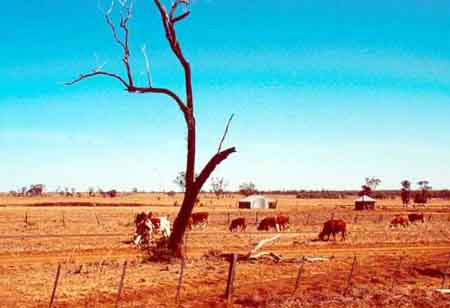
East Africa is in trouble. Somalia, Djibouti, southern Ethiopia, northern and eastern Kenya, and northeastern Uganda all affected. The World Food Program says that 23 million people are in need of emergency food relief. Food prices are rising. There has been a steady decline in rainfall over the last 20 years, rainfall patterns are less predictable.
It looks as if the climate in the horn of Africa is changing, consistent with man made global warming models.
Scarce water, scarce resources, means trouble. Population displacement, refugees, tribal conflicts. It is adding to the misery in Somalia, weakened by 18 years of internal war.
Heavy rain is expected next month, due to El Nino, but this may bring its own problems.
What to do?
First and foremost, we must hope that the politicians gathering in Copenhagen this December come up with a serious plan to de-carbonise the world economy. We can all help through Avaaz.
Even a serious, rational plan to decarbonise will not help with the East Africa situation in the short term though.
The region needs a big change in the water cycle, in a short time scale.
This is not impossible. It could be done by a massive reforestation effort, beginning at the coast, and working inland.
The key fact to know is that according to Nobel Peace Prize winner and Kenyan Green Belt Movement founder Wangari Maathai, a patch of growing rain forest 15 square kilometers in area will create its own raincloud.
It is well known that forests act as a sponge, holding water, and lifting it into the air through evaporo-transpiration. Usually, this fact is deployed to make the case against deforestation.
It is equally effective as an argument for reafforestation.
The afforestation must begin at the coast because the onshore winds are moisture laden, and can help the new forest to flourish. Solar desalination stills set up by the coast can generate the fresh water that tree nurseries need.
These projects will need major international backing, with serious money (but not prohibitive, by military standards). The planting must be carried out by and with the willing and informed consent the local communities, providing work, shelter, and benefits to those communities. And before anyone starts screaming about non-native monocultures, the species planted will be indigenous to the area, and planted with ecological sensitivity. Permaculture principles should be used.
The creative, cooperative activity required in local communities will displace energies from war making and conflict in Somalia, if rightly implemented, with good leadership from people committed to peace and democracy in Somalia.
More detail on coastal reafforestation here.
Yes, it is a big project. Yes, it is a new idea. But the journey of 10,000 miles starts with a single step.
For East Africa, this is that step.
See also:
Water Project in Israel/Palestine
Leonard Ornstein has similar concept.
Tuesday, September 08, 2009
Boris Johnson: Could he let us walk more freely?
I have sent this to the Mayor of London , Boris Johnson. Feel free to back me up here by copying and pasting your own email.
Dear Mr Johnson
A Question:
When in London, especially in the Underground, which side of the walkway should I walk on?
In Paddington Underground, it says Keep Left.
I noticed exhortations to Keep Right on another station.
No wonder people in the Underground passages Keep Randomly Dodging, Weaving and Bumping in to Each Other.
Surely, what the pedestrian needs is a convention that motorists have had for many many years: Lateralisation of Flow.
Things go more smoothly, there is more flow and less friction if everyone keeps to the agreed side of the walkway. It is more natural, more efficient.
I anticipate that you may feel that your Conservative philosophy would not allow you to order everyone to walk on this side or on that. You may feel that the individual must be free to choose his individual path, free of external compulsion.
I agree, but would say by way of rejoinder that it is not a matter of compulsion, but of suggestion and facilitation. A Nudge, as your leader might say.
By doing this, you might go down in history with the epitaph, "He may not have made the trains run on time, but at least he made it easier for people to move about on crowded walkways."
Hoping that you will appreciate the commonsense, and also the low cost, of this proposal.
With kind regards
Dr Richard Lawson
Dear Mr Johnson
A Question:
When in London, especially in the Underground, which side of the walkway should I walk on?
In Paddington Underground, it says Keep Left.
I noticed exhortations to Keep Right on another station.
No wonder people in the Underground passages Keep Randomly Dodging, Weaving and Bumping in to Each Other.
Surely, what the pedestrian needs is a convention that motorists have had for many many years: Lateralisation of Flow.
Things go more smoothly, there is more flow and less friction if everyone keeps to the agreed side of the walkway. It is more natural, more efficient.
I anticipate that you may feel that your Conservative philosophy would not allow you to order everyone to walk on this side or on that. You may feel that the individual must be free to choose his individual path, free of external compulsion.
I agree, but would say by way of rejoinder that it is not a matter of compulsion, but of suggestion and facilitation. A Nudge, as your leader might say.
By doing this, you might go down in history with the epitaph, "He may not have made the trains run on time, but at least he made it easier for people to move about on crowded walkways."
Hoping that you will appreciate the commonsense, and also the low cost, of this proposal.
With kind regards
Dr Richard Lawson
Thursday, September 06, 2007
Flooding lessons learned review, FWIW
I have just contributed to the Government's Flooding Lessons Learned Review: I sent them this link: http://www.greenhealth.org.uk/InvPump/InvPumpText.htm .
I have absolutely no confidence whatsoever that my contribution to the review will influence Government policy in the slightest.
Why do we bother, Fawlty?
I have absolutely no confidence whatsoever that my contribution to the review will influence Government policy in the slightest.
Why do we bother, Fawlty?
Wednesday, June 27, 2007
Clear that floodwater FAST
Click on the title above for a cheap, effective way of clearing large volumes of floodwater back into the river, using outboard motors otherwise hanging around uselessly in your neighbours' garage...
Subscribe to:
Posts (Atom)


