Showing posts with label climate change. Show all posts

Friday, September 09, 2016

Is climate change causing increasing migration?

It is ironic that the Daily Mail gets angry about migrants, but denies that man-made CO2 affects our planet's energy balance. The Mail must agree that Syrians are fleeing a war. A study by Richard Seager of Columbia University shows that climate change is a factor in the Syrian conflict, primarily through drought affecting food production, driving country people into towns and thereby increasing community tensions.

Also,food prices are pushed up by climatic changes, and food prices rises are often a trigger for uprisings.

One broad estimate of numbers is that 200,000,000 climate refugees will be created by 2050. This is just an estimate, but the International Organisation for Migration does not doubt that a significant number will be created.

The Daily Mail needs to try some joined-up thinking.


Thursday, September 08, 2016

"The climate has always changed"

The commonest statement from climate change deniers at the moment is "The climate has always been changing and therefore the present change has nothing to do with our CO2 emissions".

This is like a 60-a-day smoker who says "I've had loads of coughs in the past and they have always cleared up, therefore this present persistent cough has nothing to do with my smoking habit".


The scientific facts are:
  1.  The greenhouse effect is real 
  2. CO2 is a greenhouse gas
  3. We have already increased CO2 levels by 40%
  4. The earth surface temperature has already risen by nearly 1*C
  5. Already we are seeing changes in heatwaves and floods. 
  6. If we continue to pump CO2 into the atmosphere, we, our children and our grandchildren are going to suffer
  7. One of the problems is that migration is going to increase hugely.
Point 7 is there because it seems, sadly, that migration is the only thing that the people who make the  "climate has always changed" argument seem to worry about.

Wednesday, May 11, 2016

Living in the highest grossing disaster movie of all time

Humans love stories where a hero overcomes a threat to mankind. The theme of overcoming a monster goes back at least as far as Beowulf (who strangled a monster that kept eating the king's best warriors) and appears in our modern mythology in the Bond series and many other popular films.

In fact, seven of the ten highest grossing films are about defeating a threat to all people: Avatar, Star Wars, Jurassic world, the Avengers (twice), Harry Potter and the Deathly Hallows and Iron Man 3. In all, we spent a cool $12 billion on these films.

The details vary, but the basic plot is that a threat to a large group of people, if not all the inhabitants of the planet, emerges, and a hero comes forward to deal with the threat, at risk to himself (the saviour is nearly always a man), and overcomes it, usually, if not always, by violent means. The threat may be from another planet (Independence Day, The Alien), but in the Bond series, the threat is often a super-rich sociopath. It is interesting that in Avatar, the threat is from a private corporation, a mining company, and in Star Wars, it is a trading federation that offers the threat to freedom.

So we enjoy watching universal existential threats happen to other people, and we like to see a hero come forward and defeat the monstrous threat. Overcoming the Monster is the first of the seven basic plots in Christopher Booker's classification, the other themes being Rags to Riches, the Quest, Journey and Return, Comedy, Tragedy (where a character flaw leads to death), and Rebirth (where a character flaw is understood and overcome).

Of course, there is nothing wrong with our drinking up these myths. We are humans, that is what humans do. It is pleasant to watch the suffering and danger of other people, and to experience the relief when the threat is overcome. But does this process actually help us to deal with the real drama that is unfolding in our lives? Or does it hinder us? Or is it just neutral?

In our real world, a threat as big as any of the threats portrayed in the movies is unfolding. It is developing more slowly than a film script, but in the long run, the disaster scenario is equal to the magnitude of the most disastrous disaster movie ever conceived.

Let's transform our current situation into an imaginary film script, because that's the kind of thing we understand. It opens with a flood scene. A lone scientist is monitoring flooding events, and is noticing that the frequency of flood events is increasing. She takes her data to a scientific conference, where her findings are laughed out of court. However, another scientist, who has been studying droughts, comes alongside with his own, similar data. A third, who has been studying heat-waves, joins their company. They try to communicate their findings, unsuccessfully, until astronauts in an orbiting space station detect anomalous infra red waves coming from the vicinity of the moon. The source of the warming energy beams is located on the surface of the moon. Further investigation reveals an alien base on the moon that is directing energy at Earth. World leaders gather and decide to destroy the source, but all human weapons, including nuclear, are disabled before they reach the target. The warming continues; crops fail, massive migration movements take place, wars break out. An expedition is organised consisting of a group of courageous diplomats and people of action. Contact is made with the aliens, who turn our to be impeccably well-mannered, highly intelligent and technically sophisticated. They also speak very good English.  They are apologetic about the the disruption to Earth weather, but they had calculated that we would have made the diplomatic overtures at a far earlier time. Turns out that they are marketing managers for an intergalactic solar energy and numismatic corporation, and they hope that we will wish to buy their product. It transpires that their energy prices are in fact distinctly lower than our carbon-based energy technologies, due to vagaries of intergalactic currency exchange mechanisms, so a deal is struck. The aliens reverse the energy imbalances that their beams have brought about, give us some effective general advice about sustainability, and zip off home.

It's a script, no better and no worse than some of the scripts in the top 10 highest grossing films. Would it help? No, because our problem is not caused by aliens, it is caused by ourselves. Violence does not work, and there is no hero that can deal with global warming, because it is caused by our appetite for wasteful consumption of carbon-based energy. There are corporations involved, of course, but although an increasing number of well-informed people are learning to dislike them, the vast majority of us still buy their products, for many reasons, chiefly habit and convenience. We face a slow awakening from sleep. It is true that we are moving forward, but progress is far too slow, not least because our information systems and political parties are dominated by the fossil corporations who feed lies and disinformation to distort public opinion.

So we are actually living in a real disaster movie, one of our own making, where we are the population at risk, we are the dupes, with a fifth column in our midst. We are also the potential heroes. It is clearly a species of Overcoming the Monster plot. It is not a Rags to Riches plot, rather the reverse. There is no Quest or Journey involved, because all the action is taking place at home. It is certainly not a Comedy. It could easily turn out to be a Tragedy. All we can do is hope that the Rebirth theme will kick in, and as a result of experience, probably an accumulation of adverse experience. We must hope that we can learn to deploy reason, science and logic instead of passively absorbing entertaining fantasies. We must learn to change our ways and live within the boundaries that our planetary environment lovingly sets for us.

Monday, July 13, 2015

Are we heading for a mini Ice Age? Unfortunately, no.

Some very interesting work on the structure of the Sun suggests that we are heading for a period of low solar output.

Last time this happened was in the late 17th early 18th century, in the Little Ice Age, when they had ice fairs on the Thames.

The newspapers are covering this work, and the deniers will be pumping it for all it's worth in the run-up to the Paris climate change conference.

I had a look at this question in 2012
And here's a piece by a climatologist addressing the same question, only it's got formulae in it.


Basically, the changes we've made to the Greenhouse Effect will override any solar cooling that may take place. The solar minimum will cool Europe somewhat, but the overall effect will be just to ste global warming back by 10 years or so. Unfortunately. As ever, we wish that deniers and lukewarmers were right. But they are not.

Sunday, May 03, 2015

Mib

CSPOILER ALERT MIB3
Real threat to planet
Fantasy Alien, not a real threat at all


I love Men in Black. Especially MIB3, which has Griffin in it, who is able to use Truth to persuade Will Smith's dad to let Will and K save Earth from a duality of serial killer(s).

There are only 7 plot lines. This one is Defeating the Monster (who threatens all human kind) .

We are in fact in a Planet In Danger situation but the source of danger is not a personified, focussed alien monster threat, but a totally diffused, ubiquitous and everyday threat that comes from our very own tailpipes, indeed, from our farts, from the familiarity of our meaty meals, from our very own boring insignificant quotidian lives.

And the drama in the situation is in the universal denial that we are all using to "cope" with that threat.

All of us.

Not just the big deniers, like Lindzen, Lawson, and Ridley, or the phat-bass media deniers like Andrew Neil, nor the worm-tongued political deniers like Paterson, nor the pub-bore deniers like Farage, nor the corrupt power deniers like the unknown faces who determined that Ukip should not be tested in the GE2015 "debate" over Farage's intention to repeal the Climate Change Act, not just the venal deniers like Clarkson, but all of us, who all live carbon death-styles, all of us, including you, dear reader, and me, who all try to do our bit but just don't try hard enough.

Humans cannot bear very much reality.

So we lie here, in our comfortable chairs, watching a pleasant fantasy about lovable guys fighting and dying to frustrate a single (if dual) alien psychopath, and all the time we are part of a culture that is not so much invading our planet from the outside but rotting away its diversity from the inside.

MIB3 is a comedy.

The fact that we enjoy it without noticing what it is about is a tragedy.

Wednesday, October 08, 2014

Climate Science & Falsifiability

This piece is copied with permission from Philosophy Now, a non-peer reviewed magazine of philosophical ideas. I am hoping that it will help to shift the debate on climate change to a focused, critical examination of the hypothetical stance of those who believe that man-made Carbon Dioxide will not seriously affect the global climate.


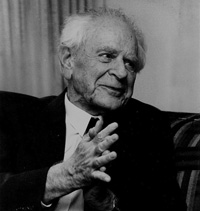
Richard Lawson shows how Karl Popper can help settle the climate debate.
Policymakers worldwide face a major headache relating to energy strategy. On the one hand, most climate scientists are warning that we must make a radical change away from reliance on carbon-based fossil fuels in order to avoid a catastrophic long-term change in global climate. On the other hand, the politicians are intensively lobbied by, and sometimes financed by, immensely wealthy and powerful fossil fuel corporations. Moreover, many popular newspapers and influential commentators are sceptical of prevailing climate science, and there is an active and noisy campaign against climate theory by contrarians in the social media. The electorate is of two minds; they do not like the apparently abnormal kinds of weather they are experiencing, but neither do they like the idea of the higher fuel bills or taxes that may be forced by decarbonisation. Small wonder that politicians have gone quiet on climate change.

Philosophers may not find this a particularly attractive arena to step into, but we have a moral duty to help unlock the truth about climate change if we can. And we do possess a key, in the form of the principle of falsifiability set out by Karl Popper in his book The Logic of Scientific Discovery (1934).
black swan
A black swan
Photo © Grant Bartley 2014
Earlier, logical positivists such as A.J. Ayer had argued that for a proposition to be meaningful, it must in principle be capable of proof (‘verification’). But Popper argued that the hallmark of a genuinely scientific proposition is not that it can be verified (because no number of observations can conclusively prove a hypothesis), but that the proposition can in principle be disproved (‘falsified’). For example, the proposition ‘All swans are white’ cannot be proved no matter how many swans you see; but it can be disproved by seeing just one black swan.

Popper & Kuhn

Is Popper still popular? W.V.O. Quine was happy to endorse falsification, although he modified the principle to make allowances for the quality of data purporting to overthrow a hypothesis, and to allow that new findings might simply force a modification of a hypothesis rather than its absolute refutation – with which idea Imre Lakatos agreed. But Thomas Kuhn in The Structure of Scientific Revolutions (1962) instead described the historic processes science follows: a consensus position or paradigm prevails in some area of science, but will eventually be overthrown by some radically new paradigm.

Both sides of the climate debate have availed themselves of Kuhn’s ideas. Climate contrarians have tried to present themselves as overthrowers of the prevailing climate science paradigm. However, there is more to being a Galileo than merely objecting to the prevailing consensus. It is necessary to possess a convincing and powerful alternative theory, and with the contrarians this is not the case, as we will see.

Indeed, the prevailing climate science might itself be characterised as having overthrown an old way of thinking. Soon after Svante Arrhenius first raised the possibility of an anthropogenically-enhanced greenhouse effect in 1896, Anders Angstrom argued on the basis of a simple laboratory experiment that the effect of carbon dioxide in absorbing infra red energy was very limited. Angstrom’s view prevailed until the 1960s, when it became understood that convection processes within the atmosphere means that his argument does not hold up. So it can be said that the contrarians represent the old paradigm; and indeed, Angstrom’s argument is still a core talking point in the contrarian community.

Not that this has much to do with the validity or otherwise of either side’s argument. In essence, Kuhn’s theory has more to do with the sociology of science than with its content. However, Kuhn did emphasise criteria for choosing one scientific theory over another: accuracy, consistency, broad scope, simplicity, and fruitfulness. Popperian falsifiability is implied by Kuhn’s first criterion – accuracy.

It is of course only too true that social and psychological factors influence what scientists accept and believe, but this is peripheral to the core of science. It’s what scientists might call ‘noise’. The central matter, the ‘signal’, is our changing understanding of objective reality, which scientists encounter as data, and data is still what they have to deal with. We can conclude that the refutation of theories through contrary data remains at the heart of the scientific method.

The Paradox of Science

Popper
Karl Popper (1902-1994)
Popper’s falsifiability principle implies that, contrary to popular misunderstanding, there is no such thing as scientific ‘proof’. The best status that even the best scientific theory can attain is ‘not-yet-disproven’. Even the most durable and revered laws, such as Newton’s laws of motion, may find extreme conditions where they no longer apply. (This does not necessarily mean that the old law is completely overthrown, but rather that its area of application becomes circumscribed.)

This absence of final, definitive proof creates a paradox: science, which we rightly regard as the most certain form of knowledge of the world, exists in a continuous state of uncertainty. In their daily lives scientists are perfectly happy with this uncertainty, not least because each new research paper can truthfully be concluded “More research is needed” – hopefully ensuring a continued supply of funding, and certainly ensuring a continued arena in which they can exercise their curiosity.

The paradox of science can be exploited in the media by opponents of any scientific case, who are able to challenge unwelcome scientific knowledge by saying, “Prove it to me! There you are, you see, you cannot!” The scientist can put forward his evidence; but unfortunately most scientists are trained to be meticulous, and meticulous exposition does not sit easily with the standard two minute popular media discussion.

This then is the predicament in which climate scientists find themselves. They can put forward the evidence, but they cannot force their audience to agree with them. They can point to the fact that carbon dioxide is a greenhouse gas, that its levels in the atmosphere have risen by 40% since the Industrial Revolution, and that we can only account for the recent rise in global temperatures by including the enhanced greenhouse effect alongside known natural factors such as solar variability and ocean currents. They can point to the observed patterns of warming as consistent with warming due to greenhouse gases in contrast to other possible causes of warming. But in the end, the reasoning is inductive, not deductive. It is not proof. To be persuaded, the listener has to recognise a pattern that satisfies a number of questions and agrees with a large number of different lines of evidence. But in the end, no person can be compelled to make an inductive judgement that he or she does not wish to make. A creationist cannot be compelled to believe the evidence of evolution, for example.

This leaves climatologists with a problem. They can make a coherent and reasonable case, presenting the facts to decision-makers. But the decision-makers can also imagine the angry cries of the climate contrarians, and the sound of strife frightens them. They ask the scientists for proof, and all the scientists can say is that further research will narrow down the uncertainties. The only way for the politician to stay in his comfort zone is by deferring the decision to act against carbon-based energy – thus allowing the situation to get worse, forcing the next set of decision-makers to face even more difficult decisions. So the controversy rolls on, with the machinery of climate contrarianism every week putting forward another question to create doubt in the minds of the public, journalists and politicians. A few climatologists and activists devote their free time to answering them, but it is like fighting a Hydra: answer one question, and two more spring up to take its place.

Disproving the Doubters

Is this how it has to be? Can a handful of dissidents, using the megaphone of mass media, sustain inaction on a process of global warming that might well end in disaster for the human species?

Philosophy has revealed the means to resolve this problem. Science may not do proof, but it certainly does do disproof. So although it may not be possible for climatologists to prove their case conclusively, itis possible to look at the contrary hypothesis and refute it. And the contrarians do have a hypothesis: it is that man-made carbon dioxide will not have a severe effect on global climate. This angle transforms the debate into a question about the degree to which the global climate will change given the known increase in greenhouse gases.

There is no reasonable doubt that, ignoring feedback mechanisms, a doubling of carbon dioxide will raise the planet’s surface temperature by about 1.2°C, because this fact is derived from calculations based on universally accepted textbook physics, and is accepted by climatologists and reasonable contrarians alike. The real debate is about climate sensitivity – or what will result from this 1.2°C rise. The Earth’s climate is a complex system of interrelated energy flows, and any warming will result in an array of changes in the system. Most of these changes provide positive feedbacks – that is, they will further increase the initial warming. A number of different lines of evidence drawing from known or deduced changes in global temperature, recent and palaeological, all converge on an eventual temperature rise of between 1.5-4.5°C, with the most likely value being 3°C. Against this, classical climate contrarians put forward a value of 0.5-1°C as their figure for the final temperature increase resulting from a doubling of atmospheric carbon dioxide concentrations. This is their hypothesis; and it is refutable through measuring and calculating the known positive feedbacks – increase in atmospheric water vapour, changes in ice and snow albedo (reflectivity), changes in vegetation, and from secondary releases of carbon dioxide and methane from soil and ocean. The main negative feedbacks (temperature reducers) are a change in heat distribution in the atmosphere, which can be calculated as slightly reducing the positive water vapour feedback, and an increase in total energy radiation from the warming Earth (a feedback which probably sets a limit to extreme planetary overheating). Several attempts have been made by sceptical climate scientists to substantiate their 0.5-1°C warming hypothesis, but each of these has ended in failure. Contrarian scientists placed their faith in clouds to provide a strong negative feedback, for instance, but recently, measurements by Andrew Dessler have shown that the net effect of clouds is more positive than negative (see Science, Vol.330, 10 December 2010).

Perhaps as a result of realising the unsustainability of the idea of ultra-low climate sensitivity, a small sub-set of climate sceptics has emerged recently, the ‘lukewarmers’, who argue for a figure somewhere below that of the consensus view but above that of the classical contrarians. However, given that their evidence base is much smaller than the evidence for higher climate sensitivity, this group is in a very weak position to claim that there is no need decarbonise the global energy supply.

In conclusion, despite the complexity and ongoing uncertainty in understanding the future effects of greenhouse gases on the climate system, one thing is certain: the hypothesis that the effect of carbon dioxide and other greenhouse gases is trivial and warrants no action simply does not hold up. It does not match the facts. It has been refuted. Journalists may not be able to understand science or the philosophy of science to any great depth, but they can understand the concept of ‘disproven’, and climate scientists can indeed disprove the contrarian hypothesis that greenhouse gases will have no significant effect on the global climate.

© Dr Richard Lawson 2014

Wednesday, February 26, 2014

Global Warming: Denial is a Thing

Roy Spencer is one of the small number of climate change deni skeptics who is also a climatologist. 
He is an Intelligent Design believer, and mistakenly provided data that seemed to show that global warming was not happening, only to discover later that the orbit of the satellite that was providing was decaying and invalidating the data.

In a recent post  Roy complains about the term "denier", and says that those who use the term are "Global Warming Nazis". 

I have responded in his comments section, and have copied my comment here, in case anything happens to my comment on Roy's blog. 


Roy,

As a retired psychiatrist, I would like to respond.

Denial is a real, common and well-recognised psychological defense mechanism that denies painful thoughts, truths, realities, facts, feelings and emotions, associated with aversion to dealing with same.

I regularly dealt with denial in my consultations.

It happens with alcoholics who refuse to accept that they are alcoholics. It happens with skeletal young women who refuse to accept that they have an eating disorder.

We all do denial to some extent, for instance, in forgetting dentists’ appointments.

Anyone who knows an individual who is in denial can see that they have a problem, except when some friends and acquaintances may be sucked in to the individual's belief system.

Every argument, fact or emotional pleading is countered by the individual in denial with “No, but what about x y and z?”

The condition can be resolved, but it needs enormous investment of supportive care, knowledge, wisdom and patience on the part of the community, mediated mainly by psychiatric services.

The critical factor in resolution of denial lies with the subject experiencing the unpleasant reality that is being denied. The alcoholic may need to experience loss of job and family before they join AA. The smoker may need to experience his heart attack before he gives up.

So denial in individual psychology is generally accepted among scientifically trained psychiatrists as a recognisable mental condition.

I leave it to you to decide whether the fossil fuel industry's pain in contemplating loss of profitability might possibly push them in the direction of denial.

Thursday, February 20, 2014

Why is the Jet Stream changing?

http://www.netweather.tv/index.cgi?action=jetstream;sess=

The extraordinary series of storms that hit the UK in January and February 2014 was due to the position of the Northern Polar Jet Stream. It was stuck in a position too far south. The image above is for 20 Feb 2014, when things have eased up a bit. Over the past weeks there has been a dark streak of wind sitting in mid-Atlantic.

If you click on the link under the image, it takes you to the excellent netweather.tv site, where you can look at a lovely JS forecast every day.

The question is, why is the Jet Stream (JS) behaving like this?

As ever in the case of climate, there is more than one factor at work. Climate sceptics stumble every time on this point. They think that climate scientists think only in terms of greenhouse gases. This is emphatically not the case. They try to gather in as many factors that they know about. Then they try to quantify the effects in computer models, and improve the models until they approach ever closer to reproducing the observed reality.

Jet Stream work is exciting, in that it is beginning to cross the bridge between climate and weather. It is new work, and therefore the uncertainties are high.

There are two main lines of enquiry: the impact of Arctic Warming on the JS, and the effect of the weakening sun.

Arctic Warming.

In 2012, Jennifer Francis and Stephen Vavrus published Evidence linking Arctic amplification to extreme weather in mid-latitudes. They suggested that the fact that the Arctic was warming faster than the rest of the atmosphere weakens the temperature gradient between mid latitude air and Arctic air. This causes the Jet Stream to become more wavy, pushing great loops further south, which also tend to get stuck in one position. This is a good explanations for many extreme weather events not just in 2014, but over the past few years, not least the dull wet summers we had in the UK 2011/2012.

Elisabeth Barnes (EB)  tested the hypothesis and claimed it was wrong, and that Jennifer Francis (JF) had misinterpreted some aspects of the data.

JF came back at EB, and claims that Barnes’ work actually backs up her theory, rather than refuting it. Her reasoning is on this page, and it seems convincing. EB was being overly critical.

Screen and Simmonds also failed to give JFs work a full confirmation. They concluded
" possible connections between Arctic amplification and planetary waves, and implications of these, are sensitive to how waves are conceptualized. The contrasting meridional (N-S) and zonal (E-W) amplitude trends have different and complex possible implications for mid-latitude weather, and we encourage further work".

In short, there is a normal interchange of scientific discussion about a new hypothesis.


Weakening Solar Activity

Another possible factor is that the Sun is entering a weaker, less active phase.

Here is a long term look back at sunspot numbers:

It suggests that the Sun is entering a cool patch.

Here is a plot of Solar activity since 1885 (red), with temperature (blue) just to show how poor the relation is between solar activity and global temperature.


However, Mike Lockwood of Reading, a solar scientist, finds that solar activity is falling very rapidly. Below is an image created on the excellent www.WoodforTrees.org site. It is from 1975 onwards, and shows sunspots in green, Total Solar Irradiance (TSI) in red (they are both indices of solar activity) and global temperature in blue. Clearly there is a pretty significant falling off in solar activity. This falling off probably accounts for part of the hiatus in global warming that we are experiencing. Deniers are predicting that it will usher in a new Ice Age, but the greenhouse forcing is stronger than the reduction in solar forcing, so it is unlikely that we will see Ice Fairs on the Thames again.


What Mike Lockwood finds is that in periods of low solar activity, the Jet Stream over Europe is more likely to get "blocked" - stuck in one place. "We show that cold winter excursions from the hemispheric trend occur more commonly in the UK during low solar activity, consistent with the solar influence on the occurrence of persistent blocking events in the eastern Atlantic. We stress that this is a regional and seasonal effect relating to European winters and not a global effect. "

Conclusion

This is not a case of either-or, of either a cool sun and Arctic warming. Both hypotheses are under examination, and of course, in science, hypotheses are never "Proved", only "not-yet-disproved".

Global weather is certainly weird, that is a fact. There must be a cause or causes for this fact. Whatever the final outcome, global warming is a problem, one that is bound to affect our weather in the end. Sea level is rising, rainfall is intensifying, that is undeniable. If it is concluded that warming is a significant factor in Jet Stream aberrations, surely even mainstream politicians will see that it is time for us to stop messing about with atmospheric chemistry, and make the transition to a carbon free world economy.

Thursday, February 13, 2014

Extreme Weather: Can We See What It Is Yet?

It is not just us here in the UK having a hard time with the weather.

Let's make a list, summarised from the excellent EcoNews:
(this list is subject to updates)

  1. UK: heaviest rainfall for 250 years, widespread flooding
  2. France and Italy also affected by flooding
  3. Western United States: worst drought in 500 years. Wildfires.
  4. Akaska, record high temperatures, triggering avalanches
  5. Australia: fourth hottest summer ever.
  6. Brazil, Sao Paolo: heat, drought, water shortages
  7. Bolivia: flooding and landslides
  8. Indonesia: flooding
  9. Mozambique: flooding
  10. Romania: heavy snowfall.
  11. Slovenia: ice
  12. Swaziland: rains failed, people starving
  13. Water shortages in Kosov@
  14. Heavy rain and floods follow drought in Zimbabwe 
  15. Japan gets heaviest snow in a century
Going a bit further back into 2013 :
We could go further back, but we need methodical attribution studies to make a scientifically credible case that connects climate and actual identifiable weather events. There may be other factors, notably the state of the oceans and the quietness of the Sun, but it is unreasonable to suppose that the ever-increasing levels of greenhouse gases are not involved.

On the other hand, as human beings, surely we can begin to join the dots, and see that a pattern is forming?

Tuesday, February 11, 2014

The connection between global warming and the current floods in the UK

How is the extreme stormy weather we have been getting in the UK related to global warming?

There is a mass of information out there, which I will now try to put it into a brief, comprehensible sequence.

First, sea levels are clearly, undoubtedly rising. Around the UK the change has been 15 cm since 1920 in Newlyn, Cornwall. This process will undoubtedly increase overtopping of sea defences.

Second, there is no doubt that rainfall patterns have changed in line with climate science predictions: warmer air can hold more water vapour, and rainfall is more intense.

Climate science predicts that increased flooding will happen everywhere in the UK, and this prediction is borne out by what we are now observing.

Studies show that the events we are looking at in Somerset are part of a trend.


  1. It has been found that there are general trends of increased volume of rainfall and runoff in winter. 
  2. Flood risk and vulnerability are increasing with increased frequency of occurrence of extreme events due to climate change &c. 
  3. Over the past 100 years the intensity of UK precipitation has increased during winter, and to a lesser extend also during spring and autumn [Abstract]
  4. Long term global records show an increase in extreme precipitation


Third, the Jet Stream position and shape is changing
Francis and Vavrus' work suggests that since warming of the Arctic is happening faster than the rest of the world, the temperature gradient between Arctic and the warmer more southerly zone is less, which means that the northern polar Jet Stream is forming meandering loops that get blocked in one position, which explains the extraordinary long series of storms that have hit us in the early part of 2014. It also explains some of the miserable summers we have had recently.

Note also that the recent extreme weather has not been restricted to the UK. There are eleven other major cases of extreme weather going on.


In more detail:
  1. Warming causes the height of the troposphere to increase.
  2. The trade winds are derived from air lifted up at the Equator that descends again at 30*N. 
  3. Trade wind speeds have doubled over the past 20 years, compared to mean speeds over the previous 80. (This comes from the excellent paper by England et al. of the University of New South Wales). Here is a useful summary of the paper.
  4. The stronger trade winds have swept warm surface water from the East to the West Pacific, where there is a pool of abnormally warm water, while in the East Pacific there is an upwelling of colder water. (Some of this warmer water is being pushed down, which accounts for a great deal of the hiatus in the increase of global surface warming, as well as the intensity of Typhoon Haiyan).
  5. This warm patch of the Pacific feeds moist air into the Jet Stream, according to the Met Office document on the recent storms. 
  6. The Pacific Jet stream has become distorted from its usual pattern (Met Office, fig 13). It swings north, then south over North America, bringing Arctic air with it, which caused the recent abnormally cold weather in the USA and Canada.
  7. The Jet Stream is speeded up because two yearly oscillation of stratospheric wind around the poles (the QBO) is going in a westerly direction at present.  
  8. Also the Polar Night Jet westerlies are twice as strong as usual.
  9. Also the warming of the Arctic is thought to be causing the Jet Stream to meander further south (Vavrus hypothesis). The Met Office is still working on evidence for this effect.
  10. Also the Atlantic is unusually warm, which adds moisture to the air.
  11. Result -an intense, moist series of storms in the UK pushed in our direction by a powerful, too-far-south Jet Stream.
Needless to say, this is an extreme simplification of the science of a vast and highly complex system, but it does show how everything is interconnected on our planetary home, and how warming of the atmosphere can have unexpected effects. 

Every skuleboy kno that Chaos Theory means that the beating of a butterfly's wing on one side of the planet can cause a storm on the other. We have been doing more than flapping a couple of square inches of butterfly. In a couple of hundred years, we have been returning to the atmosphere carbon that was sucked out of it over the course of some sixty million years. 

Time we woke up to what we are doing.


Saturday, October 05, 2013

Apply a carbon tax while we debate the best way to control carbon

Over at the Independent 
they are discussing the use of carbon markets to control CO2 emissions. My 2p:

There are a bewildering number of competing solutions to the carbon problem. 
We could easily spend from here until 2100 debating which is the most perfect solution.  
So - let us at least apply the simplest solution, the carbon tax, while the debate is going on. The tax is applied to carbon content of fuel, and its revenues are hypothecated to energy conservation,renewable energy and poverty relief. 
This latter is necessary because carbon taxes bear most heavily on the poor. 

This way is reasonable and beneficial to all except the fossil fuel producers, but let's face it, their opposition, and that of their sock puppets, is a given. 

We just have to get used to the noise they generate.

Tuesday, September 17, 2013

Debating climate change

I have put a comment in Wottsupwithatblog, http://wottsupwiththatblog.wordpress.com/2013/09/13/learning-from-my-mistakes/comment-page-1/#comment-4927
which I post here in case it gets lost. Most readers of this blog will be only too familiar with the argument and can pass on this post.

In debating with climate Pseudo-sceptics,

 Q1 is - do you accept that doubling CO2 will increase global temps by ~1C?
 If so, Q2 is - what do you accept as the figure for  Equilibrium Climate Sensitivity? 

In practice, it is very difficult to get a pseudo-sceptic to answer Q1. They have an infinite number of questions, but an aversion to answering even one single question put to them. With persistence, I have  sometimes extracted an answer, only to have them go back on it later on. At which point it is valid to terminate the discussion on grounds of inconsistency.

If the answer to Q1 is "no", there is no point in pursuing the discussion, because the pseudo-sceptic is in denial of basic physics and the greenhouse effect, and is therefore beyond reason.

The response to Q2 is interesting. Many p-sceptics do not understand what is meant by ECS, but with those that do it is possible to have a useful discussion of the evidence for and against CS values of 2-4.5C. 

The other positive outcome of a discussion framed in this way is that most reasonable Lukewarmers will accept 2C as a high bound of ECS, whereas climatology can accept 2C as a low bound. We can therefore discuss whether the agreed figure of  2C is something that can be viewed with equanimity or not.

So fruitful discussion is still theoretically possible with some kinds of climate sceptics. They are unlikely to change, but the discussion can have a positive influence on the lurkers and the uncommitted.

Saturday, September 07, 2013

Atlantic Hurricanes will increase with global warming. Why are we not concerned?

Following from this post on global hurricanes, relating them to sea surface temperatures and the Pacific Decadal Oscillation, I have been looking at the record of Atlantic hurricanes, taken from Ryan Maue's site.

I have made a composite of Maue's record of North Atlantic hurricane energy (ACE) and the Atlantic Multidecadal Oscillation, which reflects sea temperatures in the Atlantic.

Fig 1 - North Atlantic hurricane energy with AMO
It shows a reasonable correlation between Atlantic surface temperature variations and accumulated hurricane energy. The correlation is poor in 1975-6, with more hurricanes than would be expected from the AMO. Global sea surface temperatures were higher in this period. (See Fig 6 on this linked page). Thereafter the relationship is pretty good, with the exception of 2006-7 when hurricane activity was less, though the AMO did not decline. Global sea surface temperatures were in decline from 2005-8.

Throughout the record, there is a tendency for the AMO to lead the ACE by a few months.

This correlation should not come as a surprise, since higher sea temperatures are a factor in creation of tropical cyclones and hurricanes, along with low wind shear and high humidity.

Fig 2 - Global Sea Surface Temperatures since 1850


Since global sea surface temperatures have been rising consistently since 1850, we can expect hurricanes to increase along with them.

Hurricanes have a significant impact on the economy. Since economics is the sole yardstick that conservatives apply to human well-being, it is utterly and totally irrational for conservatives to try to ignore, deny, suppress or minimise concern about global warming.

On the other hand, since the only concern of fossil fuel corporations is for their profit margin over the next four years, it is perfectly reasonable and consistent for them to persuade George Osborne and the media to try to ignore, deny, suppress or minimise concern about global warming.

I hope this helps.

Wednesday, September 04, 2013

Final nail in the "Zebras are a distinct species" theory

Genius from http://wondermark.com/

Global warming and hurricanes

source theresilientearth.com


The North Atlantic hurricane season has begun, the time when hurricanes are more likely to form up. It is important to understand what is happening with hurricanes.

It is a mistake to attribute all hurricanes to man-made global warming, and it is an even bigger mistake to deny that our emissions of greenhouse gases can have any effect on hurricanes.

Experts are very cautious about confirming that hurricanes are getting worse. (Experts are always cautious, which is why it is so remarkable that all respected scientific societies have warned about global warming, and even more remarkable that media personalities such as Andrew Neil and politicians such as Owen Paterson and George Osborne should ignore the experts in this one case. But I digress.) 

One reason for this expert caution is that hurricanes have a quantifiable economic cost, and if it is reasonably certain that, say, 10% of a hurricane's cost is down to carbon emissions, the fossil fuel industry might find itself defending against a claim for 10% of the economic cost of a hurricane. And that would never do.

So it is important to find out the truth about hurricanes as far as we can.

First, the physics:
Hurricanes arise when certain factors coincide, mainly:
  1. Sea temperatures greater than 26C
  2. Low vertical wind shear i.e. little change of wind direction and strength with altitude
  3. High air humidity 
  4. Locations 20 degrees from the Equator so that the Coriolis force can set the air spinning
Global warming undoubtedly produces higher sea surface temperatures (SST) and therefore it will tend to produce more hurricanes. However, models predict that vertical wind shear is also increased by increasing temperature, so that tendency will be damped down somewhat.

Is there any evidence of increased hurricane strength with the small amount of heating we have experienced to date? 

Emanuel 2005 finds a convincing relationship between sea surface temperatures (SST) and hurricane energy measured as Power Dissipation Index, PDI

Fig1


Fig2

Click the graphs to make them bigger.  Major hurricanes are clearly getting more frequent globally, though southern hemisphere tropical storms (storms that may or may not develop into hurricanes) are becoming less frequent.

This map via Flemlose gives a good idea of where hurricanes are to be found:

Fig3


Interestingly, Judith Curry, who always tends to lean towards the no-worries view of climate, is a co-worker in a paper (Webster, Holly, Curry Chang, Changes in Tropical Cyclone Number, Duration, and Intensity in a Warming Environment, Science 2005)  that concludes yes, hurricanes are intensifying. 

Now look at this graph :

Fig 4

Apologies for the quality. I made it by using MSPaint to superimpose a Wood for Trees graph  of Northern Hemisphere SST onto Ryan Maue's PDI graph. PDI, Power Dissipation Index, is a measure of hurricane activity. I chose Northern Hemisphere (NH) SSTs because most hurricanes happen in the NH as can be seen in Fig 3.

The composite shows a sketchy relationship between SST and hurricane activity. The correlation is not perfect, as is to be expected, since SST is not the only factor in hurricane formation. There is a pretty good relationship between the 26 year trend from 1972 and 1998, with hurricane activity rising in step with rising NH sea temperatures, but after 1998 the hurricane activity falls away, although sea temperatures do not fall. Note however that the hurricane activity is still greater in 2009 than it was in 1975.

However, if we match hurricane PDI with the Pacific Decadal Oscillation (PDO) a measure of El Nino/La Nina activity in the Pacific, this is what we see:

Fig 5

I obtained the trace of the PDO from the excellent Wood for Trees site.

There is a better match between declining PDO and declining hurricane activity.

The match is by no means perfect. There is a lag between rising hurricane activity 1990-93, although PDO leads hurricanes thereafter. There is also a mismatch in 1982-90, and another in 1970-74.

Let us add global sea surface temperatures in to the picture.

Fig 6

The green line is of global SST, again from Wood for Trees, but coloured in by hand in order to distinguish it from the PDO trace. The global SST supplies heat in 1972-4 where the PDO could not account for the hurricane energy. It supplies heat to start the hurricane spike in 1990, which is then continued by the rising PDO.

In short, we can say that between them PDO and global sea temperatures do relate to observed hurricane activity, though why PDO should predominate at some times and Global SST at others is an open question.

Of course, correlation is not causation, and we would need to integrate atmospheric humidity and wind shear to get more accurate correlation.

If we assume that the PDO is a strong component of hurricane activity, what can we expect in coming years?

Fig 7


Fig 7 shows a view of the PDO going back to 1900. The period 1920-2010 suggests that there is a 60-year cycle to the PDO. It is true that one and one half apparent cycles is not enough to establish the presence of a cycle. But equally, it may be taken as suggestive evidence for a 60 year cycle. If there is a 60 year cycle, we have had 10-15 years of cooling influence from the PDO (as evidenced in the hiatus in warming of surface temperatures), so we may be due for another 20 years of negative, cooling PDO, and therefore another 20 years of relatively quiet hurricane activity.

This however is not certain. Two additional factors come into play. First, the deep ocean has taken in a lot of heat since 1980, and this heat is going to have an effect. It will inevitably emerge at some point in the future, and it may act to disrupt any regular cycle that may exist. So we may not get 20 years of relatively quiet hurricanes.

Furthermore, there is another higher frequency cycle in the ENSO pattern.

ENSO is the El Nino Southern Oscillation, and refers to the ocean surface temperatures in the Pacific, rather than the whole Pacific region climate, which is what the PDO refers to.

Fig 8

Fig 8 shows the ENSO going back to 1880. In the 130 years covered, there have been 13 warm El Nino events and 14 cool La Nina events, giving a cycle length of 9-10 years. On this cycle, we are due to move into a decade of predominantly warming El Nino events in 2014 or 2015 that will last until 2024-5.

A 5 year period of cooler Pacific temperatures may follow, and then around the year 2030, a strong positive PDO will begin, with warmer global sea surface temperatures to delivering frequent, record breaking major hurricanes which will have significant economic impact.

Anyone who is under 60 years old and who lives in a hurricane-prone part of the world should take note of this projection.

More reading: Arthur Smith predicts warming in 2013
More on this blog: Atlantic Hurricanes relate to AMO

Wednesday, July 03, 2013

Critique of the Press Complaints Commission Report on David Rose

The Press Complaints Commission's ruling on my complaint deserves a bit of critical analysis.

1) "When reporting scientific findings, publications must often present complex information to a general readership; this may involve an element of interpretation. The newspaper was permitted, under the terms of the Code, to publish such interpretation of scientific data, however strongly disputed".

So newspapers can "interpret" scientific data. This gives a lot of scope to the reporter.  We often hear the interpretation process on broadcasts, as when an expert gives a careful (but often long-winded) statement, and the interviewer says "So what you are saying is" followed by a shorter, more punchy, more black and white statement. This is how news works, with a provocative, adversarial slant in its manner of speaking.

Prof Myles Allen was "interpreted" by David Rose in the article. His account of the "interpretation" is here.
He wrote to the PCC to support my complaint, but did not make a formal complaint of his own, and so his objection was lost.

What we must learn from this is that when speaking to journalists, especially those with an agenda, is that we should insist that we are to see the final draft, and edit or remove bits about us if they are not accurate.

2) The PCC found that the phrase "plotted in retrospect" is not a misleading description of what happens in computer hindcasting. 

I argued in my original complaint:

The word "plotted" implies the action of actually entering data onto a graph, usually by hand. There is a clear implication here that the temperature prior to the present time were merely a representation of known past temperatures.

This is far from an accurate representation of computer model hind-casting, which is what DavidRose is referring to. In hind-casting, computer models are set running, and given information about the dates and intensity of climate "forcings" or inputs. In the most sophisticated models these inputs would be data on solar heating, volcanoes, the reflectivity of the planet, greenhouse gas levels, aerosol levels (e.g. smoke particles from industry), forested areas, grasslands and other relevant information. Given this information, the models will then calculate the effects and interactions of these inputs and the final output would be the net temperature for each year.


There is more, and my conclusion was ...that the phrase "plotted in retrospect" is inaccurate, misleading and a distortion of how models work.

I stand by that. 

3) Next, the Commission takes it upon itself to redefine what is meant by "world's average temperature" in order to exclude ocean temperatures. "It considered that the readers would have understood the figures to represent surface temperature, as experienced in their day-to-day lives". 

This smacks of what is one of the weakest of the contrarian talking points "It is cold outside, so global warming is not happening". Global warming is about the heat content of the globe as a whole - not about what people experience at any particular time and place. 

Ironically, having just make that breathtaking scientific judgment, the PCC confesses that it  "is not the correct body to test veracity of the scientific data relied upon by the columnist".

4) If this is all a bit abstruse, the next bit is not. "The Commission noted that, contrary to the complainant’s assertion, the article did not refer to Dr David Whitehouse as an “expert” in the field of climate change".

In the original article there is a box titled  "And here's what the experts NOW say". Dr David Whitehouse is the second expert, saying "Global warming should no longer be the main determinant of economic or energy policy". 

Try this thought experiment. In that context, would you expect Whitehouse to be an expert in ancient Indo-European languages? No, you would not. You would expect him to be expert in climatology and/or economics. 

The PCC has chosen in this judgment to ignore context, and has simply found in favour of their colleague.

5) The PCC judged that the Mail "was entitled to set out its editorial stance that historical concerns about global cooling are comparable to modern day fears about global warming".

The concerns about global cooling in the 1970s were based on seven (7) papers. There were forty two (42) contemporaneous papers that were concerned with global warming. Yet the PCC chooses to set these seven cooling papers on a par, not just with the 42, but with the thousands of papers in modern times which concern global warming.

This particular judgment is appalling. It reflects very badly on the overall judgment of the PCC and on its competence as a neutral assessor of content of its members' newspapers.

[Update 4/7/13: Enjoy this:  David Rose was taken in by a faked Time magazine cover, which he used as "evidence" that there was concern about global cooling in the 70's]

Addendum Another point has been made by Ed Hawkins, a climatologist from the University of Reading, whose graph Rose used. Rose got the uncertainty ranges wrong. 

Conclusion

The PCC would have made a better play of it if it had allowed just one criticism through - for instance, it could have said that "plotted in retrospect" is just a bit too brief to be an accurate portrayal of model hindcasting. But it did not, and its total support for Rose, and its misjudgment in point (5) above suggests that it is not an unbiased judge.

I made the complaint in good faith, believing that the Press  must not publish inaccurate, misleading or distorted information. Some said I was wasting my time, that the PCC would not criticise the Mail, whose representative sits round the table (though not on this case, of course). 

I went ahead on the same basis as the old lady that Berthold Brecht saw in a shop, during the Great Depression. She picked out some food items, took them to the counter, asked the price, then slowly walked away, leaving them there.  

Brecht asked her why she did that.

"I cannot afford food, but if we do not ask for food, maybe they will think we do not want it any more"

If we do not complain, the Mail will think that we do not know that they are misleading us.

I happen to know that the BBC is besieged with complaints from the climate contrarians. We should be swamping the PCC with complaints. As it is, the Mail is top of the league for complaints against it. 

So despite the flaws in the PCC's judgment in this case, we should continue to complain about inaccurate, misleading or distorted information in our newspapers.  Hopefully, post Leveson, the PCC will be abolished and replaced, and we can hope for a less flawed process.

[Useful posting by Carbon Brief on the PCC]

Tuesday, April 30, 2013

The climate change debate has moved on to sensitivity and 2C

I used to debate extensively with climate change contrarians on Twitter and on the blogs, but I'm more selective recently, realising that many of them are just time wasters.

The contrarians' hypothesis is that our CO2 will not have a serious effect on Earth's climate.

Some claim that CO2 has NO effect on climate. There are the ones who talk instead about CO2 being a plant fertiliser, being a trace gas and other red herrings. They are total time wasters, not worth debating since they deny physical science in the way creationists deny biological science.

Others accept the physics of the situation, and accept that doubling CO2 levels will cause a 1.2C rise in global temperature eventually, when the globe comes to equilibrium (that is, when the ocean has finished taking in extra heat. Oceans are slower to heat than land).

This second group - who call themselves lukewarmers - are worth debating time, since they do at least accept basic physics. The debate with them is over climate sensitivity - the extent to which feed backs will amplify this initial 1.2C rise.

In fact, there is an overlap between the sensitivity figure accepted by climatologists and that accepted by "lukewarmer" contrarians. It is in the region of 2C.

Therefore the debate has moved on, to the nature and stability of the climate changes that will occur about 2C. Naturally the lukewarmers say that these changes will be minor. Climatologists have a more serious view of a 2C rise.

But that's where the debate is at these days.

Monday, March 25, 2013

How does Cold UK Weather fit in with Global Warming?

Coldest March for 30 - or is it 50 - years.
Snow hits the North East.
More flooding, another house hit by a landslide.

Extreme weather. Why?

Any fule kno that our current run of bad weather, not just the present abnormality, but also the last two dark summers, is due to the northern polar jet stream being too far south. Normally it is around Scotland. Recently it was as far south as Spain.

So why is the jet stream doing this? Several factors come into play to produce any one event in the atmosphere, because it is a system.

The central cause is a "blocking high"  - a large region of settled high pressure that may stay put for weeks - in the region of Scandinavia. This diverts the jet stream south.

So why is the blocking high there? Several factors.

Melting of Arctic ice due to global warming encourages the development of regions of high pressure.
Arctic warming also weakens the contrast between northern cold and southern warmth, which normally keeps the jet stream in a tight band.

Also, the stratosphere in the region of the north pole has undergone a sudden warming event in January.
Generally, stratospheric cooling is produced by enhanced greenhouse gases, but sudden warming events overturn this pattern. The warming contributes to the development of the blocking high.

We are also in a period of solar minimum, and that also encourages blocking highs.

Therefore, when the solar activity begins to pick up again, which may happen any year now, there may be a slight lessening of the blocking high problem, but don't hope for too much of an improvement, because the Arctic warming part of the problem is not going to get better any time soon.

So that, as far as I can see, is the general situation. Now let's look at a couple of political points.

First, the argument made by contrarians "It is cold today, therefore global warming is not happening" is one of their weakest talking points. Boris Johnson used it, thereby demonstrating the paucity of his cognitive abilities. It grieves me to have to make these kind of remarks, but I have no choice. It is like getting into a fridge to prove that global warming does not exist. The fact is that we may be colder than usual here, but Greenland is warmer than usual.

Second, note that solar and greenhouse gases are both implicated, even if the solar component is relatively minor. This really needs stressing, because contrarians are continually making the mistake of saying "It's all solar", or "Why is the surface temperature flat while CO2 is rising?" They are thinking in simple mechanistic terms, not in systems terms, where several factors collude in producing a certain result.  Part of the reason for the contrarians' misconcption is because the sun is so powerful - indeed, it contributes 100% of the heat earth receives. However, although the sun does vary measurably, the variation is very small compared to its total input.

Wednesday, March 20, 2013

Complaint to PCC re David Rose's Mail on Sunday climate article

Source

Geordie Greig, Editor Mail on Sunday
Following this  post by David Rose in the Mail Online, snappily titled "The Great Green Con no. 1: The hard proof that finally shows global warming forecasts that are costing you billions were WRONG all along", I am making a formal complain to the Press Complaints Commission, and also to the BBC, since the BBC Radio 4 news on Sunday morning gave a prominent reference to the post.

Please copy my complaint below, modify it and send in your own complaint. Also, please spread it on Twitter, Facebook by email and by word of mouth. The Daily Mail is an big beast, and is a cheerleader for the dangerous do-nothing approach to climate change that has a lot of influence with the Coalition Government.

Take action. It is true that the PCC has often behaved as a toothless tiger in the past, but since it is about to be abolished (for its ineffectiveness, in part), if enough of us write about this issue, the PCC may just manage to deal firmly with the Daily Mail as a swan song.

What will happen is that the PCC will send us a response of the Daily Mail, presenting its defence. It is vital that we send back a rebuttal to that defence, which may be a month or two down the line.

Join in this campaign and make a real positive difference to the world which our children inherit!

To the Press Complaints Commission


To the Press Complaints Commission
Submission by Dr Richard Lawson
Wednesday, 20 March 2013


I wish to make a formal complaint about an article carried in the Mail Online entitled  "The Great Green Con no. 1: The hard proof that finally shows global warming forecasts that are costing you billions were WRONG all along" by David Rose, published on 16 March 2013 online and on p 22 of the Mail on Sunday hard copy.

My complaint is based on the obligations of the Press Code which state that the Press must not publish inaccurate, misleading or distorted information.

I also seek unequivocal confirmation from the PCC that the owner, editor and any agent of the Daily Mail and the Mail on Sunday are excluded from all deliberations and decisions by the PCC on this complaint, except to participate solely as defendants.

There are six points within the article where inaccurate, misleading and/or distorted information is presented.

1 . "Plotted in retrospect"
In the note in the bottom right hand corner of the figure representing temperature records,  it is written, "the 'predictions' to the left were plotted in retrospect'.

The word "plotted" implies the action of actually entering data onto a graph, usually by hand. There is a clear implication here that the temperature prior to the present time were merely a representation of known past temperatures.

This is far from an accurate representation of computer model hind-casting, which is what DavidRose is referring to. In hind-casting, computer models are set running, and given information about the dates and intensity of climate "forcings" or inputs. In the most sophisticated models these inputs would be data on solar heating, volcanoes, the reflectivity of the planet, greenhouse gas levels,  aerosol levels (e.g. smoke particles from industry), forested areas, grasslands and other relevant information. Given this information, the models will then calculate the effects and interactions of these inputs and the final output would be the net temperature for each year.

Model outputs  are checked for accuracy by comparison with the actual observed temperature record. The best models show a good match for the long term temperature trend. The match is becoming better as models become more complex, but the match is not perfect for global temperature fluctuations around the general trend. Perfection is never attainable in any human construction, but models become more accurate as they are developed.

Some models will spontaneously generate their own ocean currents such as El Nino and La Nina. However, they cannot yet represent the ocean currents accurately enough to coincide with the timing of actual currents. Since a cool phase of ENSO (La Nina) ocean currents are a strong factor in the post 1998 plateau of surface temperatures increases, the models have not represented this surface temperature levelling. An additional cause of the models’ failure to anticipate the levelling off of the surface temperatures is that the programmers did not anticipate the additional cooling effect of aerosol (smoke) particles from China’s industrial surge in the early 21st century.

If they had been instructed to indicate strong cooling ENSO currents - if indeed the currents were "plotted" into the models - the model output would have displayed the post 1998 levelling off of surface temperatures.

It is therefore my contention that the phrase "plotted in retrospect" is inaccurate,  misleading and a distortion of how models work.

2. "The forecasts have also forced jobs abroad as manufacturers relocate to places with no emissions targets".

The Mail on Sunday and Mail Online must supply instances where more than one manufacturer has relocated to places with no emissions targets where the motivation of "no emission targets" was the sole, or the primary driving factor, as opposed to a subsidiary factor, with, for instance, lower wage costs being the main factor.

If the Mail cannot supply these instances, the sentence is inaccurate and misleading.

3 Rose quotes Prof Myles Allen: "Academics are revising their views after acknowledging the miscalculation. Last night Myles Allen, Oxford University’s Professor of Geosystem Science, said that until recently he believed the world might be on course for a catastrophic temperature rise of more than five degrees this century. But he now says: ‘The odds have come down,’ – adding that warming is likely to be significantly lower".

However, Allen has also said:
 "While every new year brings in welcome new data to help us rule out the more extreme (good and bad) scenarios for the future, it would be equally silly to interpret what has happened since the early-2000s as evidence that the warming has stopped."
( Source: http://www.channel4.com/news/met-office-global-warming-predictions-revised-down)

Another quote from Prof Myles Allen: "Comparing the expected temperature for 2013-2017 with a single exceptionally warm year (1998), as some reports have done, is just daft. 1998 was around 0.2 degrees warmer than the 1996-2000 average, largely thanks to a massive, once-a-century El Nino event. The IPCC predicted a warming of 0.1-0.2 degrees per decade due to human influence back in 2000. That means the one-off impact of that El Nino event was equivalent to about 20 years of the expected background warming trend So, unsurprisingly, 20 years later, expected temperatures have risen so that an average year is now as warm as that exceptionally hot year.

(Source: http://www.guardian.co.uk/environment/blog/2013/jan/09/global-warming-met-office-paused)

The PCC will need to interview Prof Myles Allen to find out from him whether the quote by David Rose is misleading, inaccurate, and distorts his position.

Rose does have a past history of distorting statements by climate scientists to fit his agenda. See http://judithcurry.com/2012/10/14/pause-discussion-thread/


4. "The graph confirms there has been no statistically significant increase in the world’s average temperature since January 1997"

This statement might possibly  be true of the world's average surface temperature, but the phrase "world's average temperature" implies that all temperature measurements are included. When the continuing increase of ocean temperature is included, a statistically significant increase in the world's average temperature has continued since 1997.


The statement is therefore inaccurate and misleading.

The same inaccuracy is repeated later: "The awkward fact is that the earth has warmed just 0.5 degrees over the past 50 years". That again refers only to the earth's surface temperature, and hides the fact that more heating has gone into the oceans, and will inevitably emerge in the future to push surface temperatures higher.

Examination of the surface temperature record since 1975 show six periods of plateau or decline  similar to the 1997 plateau. There is a graph here
http://planet3.org/wp-content/uploads/2013/01/SkepticsvRealistsv3.gif
which demonstrates these periods.

The point, as any competent science journalist would be keenly aware, is that it is long term, multi decadal trends that are important, and that by selecting start and end points on a noisy graph, trends of any variety can be produced.

5. David Whitehouse is presented as an "expert".  In fact his expertise is in astrophysics, not climatology, and the article hides the fact that the Global warming Policy Foundation is a think tank whose primary purpose lies in opposing decarbonisation of the UK  economy.

This is misleading.

6. A box repeats the talking point about "global cooling" theories in the 1970s. In fact, this was a theory put out by a very small group  of scientists which was seized upon and amplified by the media at the time.  Seven papers in the sixties and seventies suggested cooling, while six times that number suggested warming.

Source: https://ams.confex.com/ams/pdfpapers/131047.pdf

It is inaccurate, misleading and a distortion of the truth to compare that shortlived period of speculation by a few in a period when modern climatology was in its infancy with the very large body of present climate  science which is agreed by the overwhelming majority of professional climatologists.


In Conclusion

The current scientific consensus is opposed by a small minority of highly vociferous opponents whose underlying motive is that if global warming were true, it would require interference in the working of the free market, particularly the free market in fossil energy, which is anathema to their political ideology.

David Rose is well aware of the criticisms that have been made of his position, since he has made these points in print several times before, and each time the scientific community has responded to them.. Instead of taking these criticisms on board, or engaging with them and attempting to refute them, he is given the privilege of repeating them in their original form in a popular and highly influential national newspaper. The effect of his repetitions is to reinforce an erroneous belief in the population that man-made greenhouse gases have an insignificant effect on the planet. This is a misleading, inaccurate and distorted message, and it has a detrimental effect on Government policy, since the clear scientific consensus is that human greenhouse gases have a definite impact on the planet (even “sceptical” scientists agree that a doubling of CO2 will increase planetary temperatures by about 1.2 degrees Celsius), that this impact will be very serious, and that policy makers should take steps to decarbonise the world economy.


I submit that the article by David Rose presented in the Mail Online and the Mail on Sunday on 16th March 2013 is inaccurate, misleading and a distortion of the truth. I ask the PCC to require the newspaper to present a retraction and a correction of the facts, which are to be given equal prominence to the original article.

Thank you for giving your attention to this serious matter.

Sincerely

Richard Lawson
MB BS, MRCPsych

[Update: the PCC found 100% in favour of their colleague. My critique of their judgment: http://greenerblog.blogspot.co.uk/2013/07/critique-of-press-complaints-commission.html ]